About Me

My photo
Lover of anything vintage. I spend my free time looking at antiques,watching and collecting classic films,and reading some of the greatest literary classics known to man.This blog is just my way of sharing my interests with other people.
Showing posts with label star of the month. Show all posts

Wednesday, January 22, 2014

New year, new look...

Hello everyone!

Happy 2014!
We are excited to post this first entry of the new year, even if it is fairly small and seemingly insignificant.
Thank you once again for participating in another immensely successful year of A Very Vintage Christmas throughout the month of December.
Have you noticed the new look here on the site? This will be our design for 2014, and we are excited that you finally get to see.
Things will run according to a regular schedule beginning in February, with regular Star of the Month and Movie of the Month posts. We would also like to begin Silent Saturday segments again, which would be once a month. You can also be looking forward to a classically sweet post in honor of Valentine's Day within the next couple weeks.
We are ready to take part in all kinds of classic adventures with you in 2014!
Stay tuned!


Keep updated with us!
Did you know we have a Twitter AND a Facebook account?
Follow us HERE
Like us HERE

Sunday, January 6, 2013

"A charming woman is a busy woman."-Loretta Young

Before I really get started on this post, I'd just like to say a HUGE thank you from Think Classic for your support and views as readers during our A Very Vintage Christmas campaign.It was another very successful holiday season, and we already can't wait for next year!

However, now it's time to get back to business. The new year has come and a new month has started, which means that there is a new Star of the Month for Turner Classic Movies!

STAR OF THE MONTH
Loretta Young
Born January 6, 1913
Died August 12, 2000

Michaela Gretchen Young was born in 1913 in Salt Lake City, Utah. Even after her family relocated to Los Angeles when she was three, she was brought up in a religious background. She officially began to act along with her two sisters (Polly Ann and Sally Blane) the next year, at the age of four, and she would remain active in her career for the rest of her life. Her very first moving picture was the silent film The Primrose Ring (1917).  It was not long after when she was given a contract by John McCormick, who investigated the young girl at his wife Colleen Moore's urging. She had roles in 6 more films, including The Sheik (1921), and she was billed Gretchen Young for all of them. It was not until the year 1928 that she was given the name Loretta by Colleen Moore, who later revealed that she came up with the name because it was the name she had given to her favorite, most beautiful doll at one time.
Loretta continued to act throughout the late twenties and early thirties, but she would often be given roles that flew under the radar and which were not credited. It was not until her film Three Girls Lost (1931) was released that she gained some good notoriety and began to build a firm and stable career. She starred in films of many different genres including the drama Life Begins (1932), the romance Second Honeymoon (1937), the mystery A Night to Remember (1942), and the holiday favorite The Bishop's Wife (1947). She also had prominent roles in such pictures as The Hatchet Man (1932) and She Had to Say Yes (1932), which were films released before the Production Code took effect. Because of this they contained many things that were banned from the big screen beginning two years later in 1934--things such as drug use, depiction of violence/murder, and sexual content.  While she was quite successful in all genres, Young excelled in comedies such as I Like Your Nerve (1931), Ladies in Love (1936), Bedtime Story (1941), Mother Is a Freshman (1949), and many others.
Since she had been acting since the age of three and had already built quite a career for herself, Young retired from film in 1953. She then opened the door to the realm of television. She hosted her own show, The Loretta Young Show beginning in 1953. It lasted for 9 years and, at the time, was the longest running prime-time network television show hosted by a woman.
Young had a troublesome personal life, which she went to great lengths to keep private, although her attempts sometimes failed. She was first married by elopement at the age of 17, though the marriage only lasted for one year after which time it was annulled. In 1935, Young was working on the film adaptation of The Call of the Wild when she met fellow actor Clark Gable. The two had an affair, which they tried to keep secret due to moral standards that were set for workers in the film industry at the time. Things got very tricky when Young discovered she was pregnant. If the details of her pregnancy were uncovered it could have destroyed both her and Gable's careers. Young tried to be discreet, claiming a lasting illness she had contracted as a child, disappearing for several months to travel Europe. Her daughter Judy was born in secret and then placed in an orphanage for a very short period of time until Young's mother picked her up and brought her home. From that time Young publicly claimed that she had adopted Judy, and she raised her with her second husband Peter Lewis, whom she married in 1940. Unfortunately, as Judy grew older, many hereditary features from her father became more prominent--especially her "Gable ears." Young had her daughters ears pinned back via cosmetic surgery when her daughter was 7 years old, but rumors continued to fly. Young vehemently stuck to her story of adoption until her own daughter asked her about it when she was an adult, and then she finally admitted the truth. In her later years, Young devoted her time to charity work with lifelong friends and fellow actresses, Irene Dunne, Rosalind Russell, and Jane Wyman.
Loretta Young starred in over 100 films over the course of her career. She won an Academy Award for Best Actress in 1947, and was nominated for another in 1949; she also was awarded 3 Emmy Awards for The Loretta Young Show, and was awarded a Golden Globe in 1986. She died of ovarian cancer in 2000 at the age of 87.


"Giving credit where credit is due is a very rewarding habit to form. Its rewards are inestimable."
-Loretta Young

"Nearly everyone I met, worked with, or read about was my teacher, one way or another."
-Loretta Young

"I'm grateful to God for His bountiful gifts..He gave me courage and faith in myself."
-Loretta Young


As January's Star of the Month, you can watch some of Loretta Young's movies every Wednesday night this month, beginning at 8pm ET on Turner Classic Movies.
For this month's schedule, click on the link:

Sunday, December 23, 2012

"Catastroph!"

A Very Vintage Christmas post #8

Today is December 23, so there are two days until Christmas!
We have a classic Christmas film for you today, but it also happens to be in conjunction with TCM's Star of the Month for December, so here she is:

STAR OF THE MONTH
Barbara Stanwyck
Born July 16, 1907
Died January 20, 1990

Barbara Stanwyck was in fact born as one Ruby Catherine Stevens in Brooklyn, New York in 1907. She had a difficult upbringing and developed a tough skin because of it. She was the youngest of five children who were orphaned from a young age. Her mother was killed in a streetcar accident when she was 4 years of age, and soon after that her father left for a job on the Panama canal dig and he was never seen or heard from again. Ruby was left in the care of one of her sisters who was only 5 years older than herself. She stayed with her older sister, Mildred, until the latter decided to pursue a career in show business. From that point on Ruby and one of her brothers were placed in innumerable foster homes. During summer vacations, Ruby was reunited with her sister and would travel and tour with her, memorizing routines and developing a passion for performance. Mildred tried to discourage her from getting involved in the business, but Ruby desperately wanted to be on stage--to be noticed. She never attended high school, and when she was still just 15 in 1923, she landed herself a job at a night club in Times Square. She was only there for a short time until she auditioned and won a part as a Ziegfeld girl for two seasons.
Ruby worked the circuit as a chorus girl for the next 3 years until she met director Willard Mack in 1926. At the time, Mack was attempting to cast the roles for his play The Noose, and Ruby was referred to him by a friend and mutual acquaintance. She was given the part, but the play was not successful until it was rewritten with adjustments to her character. After the tweaks were made, it became an amazing success on Broadway. It was during this time that Ruby Stevens officially became Barbara Stanwyck. The name of her character was Barbara, and the last name was taken from another actress. And thus, a star was born.
In 1927, the new Barbara Stanwyck was cast in a leading role in the hit show Burlesque. She quickly began taking up small parts in silent films later that same year. It was also during this time that she met her future husband, Frank Fay, while working on the stage. They were married in 1928. The two were married less than 10 years, and reportedly fell apart due to career differences. Fay was also an actor, but he could not successfully switch from silents to talkies, whereas Stanwyck's career skyrocketed shortly after talkies rolled into production. Fay also had alcoholic tendencies and was abusive to his wife in public.
From her first talking picture in 1929, The Locked Door, Stanwyck just kept going and building momentum as she went. She quickly was cast in memorable pictures such as Ladies of Leisure (1930), Stella Dallas (1937), The Lady Eve (1941), and Sorry, Wrong Number (1948). She was also considered for the part of Scarlett O'Hara in the film adaptation of the classic novel, Gone With The Wind.
Stanwyck went on to marry fellow actor Robert Taylor in 1939. She was very hesitant to get involved with anyone else after her previous disastrous relationship, but Taylor was persistent. She claimed that he was the love of her life, and they were happy for a while, but he began to stray and the couple fell apart after a while. They agreed that it was best to divorce, and they officially did so in 1951. Stanwyck stayed active after her divorce, but her personal life took a toll on her career and she slowly began to decline in the film industry. After 1957, she began to dabble in the television industry, and had some minor success.
Barbara Stanwyck was looked upon as the friendly face of Hollywood. She was known for showing warmth and kindness to all of the crew and backstage workers on her films, and she was a great favorite with all of her costars. During her time in the film industry she starred in over 80 motion pictures, and won an Academy Award in 1981. She died of heart complications at the age of 82 in 1990. There was no funeral according to her wishes.


"I'm a tough, old broad from Brooklyn. I intend to go on acting until I'm ninety and they won't need to paste my face with makeup."
-Barbara Stanwyck

"'Career' is too pompous a word. It was a job and I have always felt privileged to be paid for doing what I love doing."
-Barbara Stanwyck


And now, for our Movie of the Month pick starring Barbara Stanwyck, which is also the main part of our post for A Very Vintage Christmas today:

Christmas in Connecticut
1945
Starring Barbara Stanwyck, Dennis Morgan, Reginald Gardiner, S.Z. Sakall, and Sydney Greenstreet

During World War II, a smart, young, single woman by the name of Elizabeth Lane (Stanwyck) has a job as a writer for a successful housekeeping magazine. To all of America, Elizabeth Lane is a loving wife, nurturing mother, and sensational cook who lives on a country farm in Connecticut. Only three of her closest friends know that she is in fact a single woman who cannot cook to save her life and lives in a small apartment in the city. Certainly her boss, Alexander Yardley (Greenstreet) has no idea--he's an old stickler for the truth and is in favor of anything that will boost circulation. There doesn't seem to be any reason to inform Mr. Yardley about Elizabeth's real home life...that is, until Mr. Yardley receives a letter from a nurse who is engaged to a sailor and she wants him to be able to go and spend Christmas in a good, happy, comfy, traditional home. Mr. Yardley thinks it will make for an excellent story--Elizabeth Lane, America's model housewife, taking in a naval hero for the holidays.
Elizabeth finds out about what Mr. Yardley is planning and she is devastated, knowing that she must tell Mr. Yardley the truth and lose her job. Whenever she goes to meet with him, she can't work up the courage to tell him that she is not a housewife from Connecticut. Then, she is even more dispirited than before when her friend John Sloan (Gardiner), who has always been determined to marry Elizabeth even though she's not interested, pays her a visit. John is an architect and he mentions in passing that he has a house in Connecticut, which sparks an idea in Elizabeth's head. In order to keep her job, Elizabeth says that she will marry John; that way the two of them can go to his country house in Connecticut and receive the sailor there and pretend that she is the housewife she claims to be in her magazine articles. John thinks her whole predicament is rather ridiculous, but he goes along with it because it means Elizabeth is finally accepting his proposal.
So, shortly before Christmas, John travels to his country farm in Connecticut with Elizabeth, who insists on bringing her "uncle" Felix (Sakall) who is a professional chef and who has been giving her recipe ideas for the magazine articles for years. Everything is ready; they even have a baby to complete the picture because the housekeeper watches a baby whose mother works at a munitions factory during the day. The only problem is that Elizabeth has qualms about marrying John since she knows she doesn't really love him. They are supposed to get married as soon as they arrive at the farm by a justice of the peace but Elizabeth manages to put it off. John gets upset and insists on knowing what they're supposed to do, but she manages to placate him by saying that they will just pretend they are married but she will sleep in the guest room at night. Things only get more complicated when the sailor arrives two hours early and Elizabeth very quickly falls head of heels in love with him. Then things get even more crowded when Mr. Yardley himself also joins them for Christmas.
Everything turns into a big, jumbled mess as Elizabeth tries to keep up her act so she doesn't get fired, but she can't help showing her attraction to the sailor, Jefferson Jones (Morgan). Uncle Felix helps her keep her secrets for a while but eventually Mr. Yardley starts to catch on, but he only picks up on some of the details--he thinks that Elizabeth and John really are married but that she is having an affair with Jefferson. Everything gets more confusing and tense until the truth finally comes out. Elizabeth quits her job and is heartbroken because she never realized Jefferson was engaged until his fiance turned up at the farm. But new truths are being unveiled all over the place and Jefferson discovers his fiance came to break the news that she is now married to somebody else.
Everything seems melancholy and chaotic until Uncle Felix steps in. He gets Elizabeth her job back with a pay raise, and he fills in all the gaps for Jefferson so that he knows Elizabeth is in love with him. They then reconcile and proclaim their love for each other, and everyone has a very merry Christmas in Connecticut, after all.


Christmas in Connecticut is a great family Christmas movie. It is a true comedy of circumstance and is full of humor, and a little romance too, of course.
It is one of my favorite Christmas movies and I even own a copy of it myself.


Alright, so tomorrow is Monday so we will be doing a post then for Christmas Eve.
I can't believe Christmas is so close at hand! We here at Think Classic truly do wish you all a wonderful, happy, blessed Christmas. Be safe this holiday season, and in light of recent tragedies that have befallen those across the country and most especially in the Northeast: as you reach out to those around you whom you love this Christmas, remember those who have now lost their loved ones. Please keep them in your thoughts and prayers.
Have A Very Vintage Christmas!

Monday, October 8, 2012

"Write anything you want about me.Make something up.Hell,I don't care."

STAR OF THE MONTH


Spencer Tracy
Born April 5, 1900
Died June 10, 1967

At the beginning of the 20th century, in Milwaukee, Wisconsin, Spencer Bonaventure Tracy was born to Irish Catholic parents Caroline and John Tracy. He was the youngest of two children, having an older brother named Carroll. Tracy did not have a difficult upbringing, yet he was typically written off as a "problem child" throughout most of his youth. He was hyper, inattentive, disrespectful, and made poor grades in school. While he was still in elementary school, Tracy's parents made the decision to hand him over to church authorities, in the hopes that they could help modify his behavior. During this time he had some slight attitude changes, but did not really turn his life around until he was in high school. As a teenager, Tracy attended a Jesuit academy and he credits the school in helping him grow up and become more respectable.
It was also during high school that Tracy's passion for acting and theater was ignited. He was friends with fellow future actor Pat O'Brien, and the two of them would spend much of their time attending and analyzing plays and acting for friends. Yet, even after his attitude adjustments, Tracy was never one for academics, so he enlisted in the Navy as soon as he turned 18. He was discharged after a year, and did not know what to do with himself. His father, John Tracy, desperately wanted one of his sons to go to college, so after much pleading, Spencer went back to school to achieve his undergrad diploma. He then was accepted at Ripon College, where he majored in medicine.
Tracy fit in well at Ripon, and he soon made many friends. He quickly affiliated himself with the drama team and began acting, even forming an informal troupe with his friends, calling themselves "The Campus Players." In 1921, the college debate team went on tour, taking Tracy to New York. While there, he decided to take his chances and auditioned for a place at the American Academy of Dramatic Arts. The school officials were impressed with Tracy and offered him a scholarship, which he accepted, and he began taking classes at AADA in the spring of 1922. As soon as he graduated from the Academy, Tracy took up work with a small acting company, but he was not satisfied with his small roles, so he soon left and joined with another. Tracy moved from company to company, and even took two gigs on Broadway for the next three years, but nothing was successful. It was a low period for young Tracy, who not only had to take care of himself but also felt a new obligation to take care of his new family, having been married in 1923. He later said, "There were times when my pants were so thin, I could sit on a dime and know if it was heads or tails." Finally, in 1926, Tracy took a part in the Broadway play Yellow. He decided that if he couldn't make a go of it and launch his career this time around, then he would quit acting for good and take a regular desk job. Yet it became clear on opening night that Yellow was a success, and that the young Tracy had extraordinary talent. The play's producer, George M. Cohan specifically wrote his next play with a part for Tracy, and then another after that. The next play, however, never made it to the stage, and Tracy once again considered quitting the business. Eventually, Tracy was approached and offered the part of a desperate madman being sent to death row in The Last Mile. He warily accepted, and on opening night in January of 1930, Tracy was called forward for 14 curtain calls for his outstanding performance.
With the invention of "talkies" in the 1930s, new actors and actresses that could handle speaking parts were in demand. Scouts for Hollywood studios were sent out to recruit and bring promising talents in for screen tests, and one of those scouts found Tracy. After being discovered, Tracy was offered a contract with Fox and made his film debut alongside Humphrey Bogart in Up the River (1930). Tracy stayed with Fox for the next 5 years, and then he moved to MGM. Some of Tracy's most well recognized work was produced with MGM over the next twenty years that he was with them. It was also while working at MGM in the 1940s that he met actress Katharine Hepburn. Tracy was still married to his wife at the time, but the two were amicably separated and had no intention of divorce because of their Catholic and Episcopalian backgrounds.He was also no longer living with his wife and two children, after he discovered that his son was deaf and he felt guilty and blamed his son's loss of hearing on his past deeds. So it was that, strange as the circumstances were, Hepburn and Tracy embarked on a partnership to go down in history. Their relationship was even used by the studio to produce box office hits, and the two are still today primarily known as much for their partnership on the screen as off. They starred in 9 films together. The two were completely devoted to each other and remained together for the remaining 26 years of Tracy's life.


Tracy was a true star and a great asset to Hollywood throughout his career. During the 45 years of Tracy's career, he starred in over 85 productions, and won two Academy Awards for his performances in Captains Courageous (1937) and Boys Town (1938). Spencer Tracy died after collapsing due to a major heart attack in 1967. Hepburn was with him at the time, and she later recalled that afterwards, "He looked so happy to be done with living, which for all his accomplishments had been a frightful burden for him."

MOVIE OF THE MONTH
Father of the Bride
1950
Starring Spencer Tracy, Joan Bennett, and Elizabeth Taylor

Stanley Banks (Tracy) is a completely ordinary man. He is a successful lawyer, he lives in a comfortable home, has a beautiful wife, Ellie (Bennett), and a lovely daughter, Kay (Taylor). The only problem with his comfortable, ordinary life is that it is about to turn upside down because his daughter (who, surely, is much too young) has decided that it is essential to her happiness to get married.
Not only is Stanley against the idea of his little girl getting married at all, but he begins to question the entire thing as he realizes that his once reassuring dreams of a quiet, cheap ceremony are out the window and gone forever. Problem after problem arises, and Stanley keeps his cold feet planted in his stubborn shoes until he realizes that by causing so much trouble, and by being so unwilling to contribute to his daughter's big day, he is jeopardizing her happiness. So, despite the fact that it hurts him and his wallet in ways he'd rather not think about, he decides to clean up his act and make Kay's wedding a day she will never forget. And even though it cost him a fortune, trashed his home, and he had to give away his little girl, he decides that it was worth it after all.


Father of the Bride was a huge comedic hit at the box office when it was released in 1950. Tracy was applauded for his portrayal of Stanley Banks, and audiences everywhere fell in love with Elizabeth Taylor all over again, as this was considered one of her first "adult" or mature roles. The film was so successful that the studio brought all the actors together for a sequel the next year, entitled Father's Little Dividend. The film was remade in 1991 starring Steve Martin as Banks, and many of the details were kept the same.


"This mug of mine is as plain as a barn door. Why should people pay thirty-five cents to look at it?"

"Come to work on time, know your lines, and don't bump into the furniture."

"I'm disappointed in acting as a craft. I want everything to go back to Orson Welles and fake noses and changing your voice. It becomes so much about personality."

Monday, September 10, 2012

"I am not a has-been. I am a will-be."

STAR OF THE MONTH
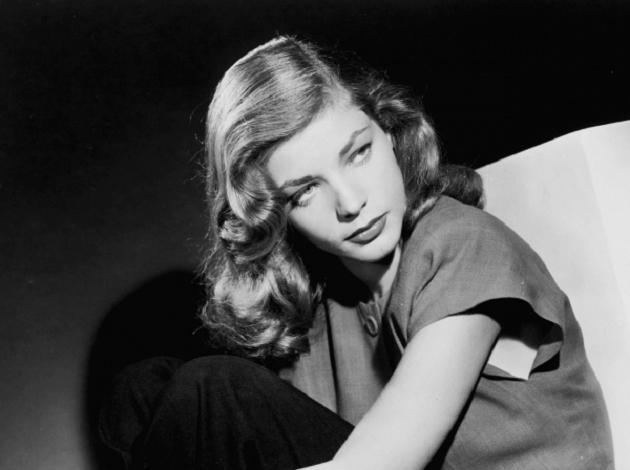
Lauren Bacall
Born September 16, 1924
Betty Joan Perske was born to Jewish immigrants, Natalie Weinstein-Bacal and William Perske, in the Bronx, New York, 1924.  When she was only 5 years old, her parents divorced and she never kept in contact with her father.  She did, however, have a very close relationship with her mother throughout her life.  It was after her parents' divorce that her mother, Natalie, changed her last name to the Romanian form of her maiden name, Bacall, which Betty would later also adopt as her surname.
As a teenager, Betty Perske, now going by Betty Bacall, enrolled in the American Academy of Dramatic Arts.  In order to pay for school, Bacall worked as a theater usher.  Later on, she began to test the waters in the world of modeling, and it was due to these jobs that she got her big break.  In 1943, the wife of film director Howard Hawks saw Bacall on the front of Harper's Bazaar Magazine.  She approached her husband about this new, attractive, striking face and convinced him to contact her and invite her to do a screen test for the upcoming film To Have and Have Not (1944).  Hawks not only had Bacall audition for the film, but was so impressed with her that he moved her out to Hollywood, signed her to a seven year contract, and began paying her $100 a week.  Essentially, Hawks took on the role of manager for the new, young actress.  His wife, Nancy Hawks, helped train her in other ways, making sure she was always dressed in the latest fashions, and teaching her other little graces and types of etiquette.  It was during this time of transition that Bacall (now officially renamed Lauren by Hawks) developed two of her biggest career trademarks.  She was formally trained to speak in a slower, deeper, more masculine tone of voice, which she later on became known for.  She also developed her trademark known as The Look, where she would angle her face downwards and look up at the camera through her lashes.  Believe it or not, The Look was developed out of nerves, but it worked.
It was also during the filming of To Have and Have Not that Bacall met Humphrey Bogart for the first time.  Though he was 25 years her senior, the two fell head-over-heels in love and began an affair.  It was a well-publicized relationship, with the public affectionately referring to the couple as "Bogie and Bacall."  They married in 1945, when Bacall was 20 and Bogart was 45, and they remained married until 1957, when Bogart died after battling esophageal cancer--a hard loss for Bacall, who later said,
"A man's illness is his private territiory and, no matter how much he loves you and how close you are, you stay an outsiderYou are healthy."

Bacall worked on several more films in the latter half of the 1940s, including Confidential Agent (1945), The Big Sleep (1946), and Dark Passage (1947).  Her trademarks helped her create an on-screen persona that made her stand out in the film noir genre.  But Bacall also played notable parts in other genres as well, such as the comedy How to Marry a Millionaire (1953), and the 1950 film Young Man with a Horn, which is considered to be one of the first big-budget jazz films.
Bacall has had a brilliant and full career, starring in over 60 productions, including television appearances, Broadway, documentaries, etc.  She has been nominated for numerous Golden Globe, BAFTA, and SAG awards over the years, and was chosen to receive an honorary Academy Award for her achievements in film in 2009.  She is still active at 87 years old.


MOVIE OF THE MONTH
Designing Woman
1957
Starring Lauren Bacall, Gregory Peck, and Dolores Gray

A sports journalist by the name of Mike Hagen (Peck) goes on vacation and meets elite fashion designer Marilla Brown (Bacall).  Despite having almost nothing in common other than being living, breathing human beings, the two decide to get married before anyone (including themselves) really knows what's going on.  Reality starts to hit when the newlywed couple returns to New York and tries to mesh their separate lives together--Marilla being dunked into a world of sports-crazed men, and Mike being looped into a life that revolves around clothes and the elite, dramatic, high-fashion social circle of his new wife.  Their differences are further underlined after it is decided that Mike will move into Marilla's East Side apartment.  Marilla goes to her husband's old bachelor pad and discovers not just that he has a poor sense of style, but also a picture of actress Lori Shannon (Gray)--Mike's ex-flame.  She tells herself that it surely means nothing, and tries to disregard it yet, as time goes on, she feels like Mike is keeping a secret, and she begins to fear the worst.
Mike certainly is keeping a sercret--but it's not at all what his wife thinks!  He has recently run into a bit of trouble by exposing boxing promotor Martin J. Daylor as a crook and a fraud.  Mike is informed by his co-worker that Daylor has been snooping around, leaving messages, and making threats on Mike's life.  But Mike doesn't wish to alarm or scare off his new wife, who is not accustomed to his lifestyle, so he decides that it is knowledge that Marilla does not need to be burdened with.  Things get sticky as time goes on--Marilla just gets more suspicious that Mike is having an affair with Lori Shannon, which is only made worse when Mike has to go into hiding, pretending to be travelling with a sports team, yet none of the stories he tells his wife over the phone seem to match up.
Things just continue to slide downhill until everyone--Mike, Marilla, their friends, Daylor and his cronies--end up in a back alley and fight it out.  But all ends well when Mike is forced to defend Marilla and the two of them realize that, even with all their differences and misunderstandings, they got married for a pretty good reason--because they love each other.


This comedy of circumstances was directed by Vincente Minelli, and the film did incredibly well at the time of its release.  Bacall and Peck had excellent on-screen chemistry, and it was one of those rare movies for Bacall that brought out her witty side and hilighted her comedic talents.

You can catch Designing Woman starring Lauren Bacall on Turner Classic Movies on Wednesday, September 19, at 3:45 am ET.


"I used to tremble from nerves so badly that the only way I could hold my head steady was to lower my chin, practically to my chest, and look up at Bogie."

"You can't start worrying aout what's going to happen.  You get spastic enough worrying about what's happening now."

"I think your whole life shows in your face, and you should be proud of that."

Tuesday, July 3, 2012

"I can't think of anything more exciting than trying to be an actor."

STAR OF THE MONTH


Leslie Howard
Born April 3, 1893
Died June 1, 1943

Leslie Howard Steiner was born in Forest Hill, London, England in April of 1893. He was one of four children born to Lilian and Ferdinand, members of the upper class. Leslie was well educated, but did not attend University. During WWI, Howard enlisted and served in the British Army for a short period. His acting career began after his involvement in the war, when he took to the stage in 1917. He was moderately successful at the London theater, but his launch to success didn't come about until he came to America in the 1920s. In 1929, he found himself as the lead character in the play Berkeley Square, which he would go on to play film adaptation in 1933--the beginning of his film career.
For his film roles, Howard most often portrayed the traditional old fashioned Englishman. Occasionally, with much success, he showed a different side of himself in playing characters such as Sir Percy Blakeney in The Scarlet Pimpernel (1934), or Professor Henry Higgins in Pygmalion (1938). As time went on, Howard also played his hand with romantic film roles, showing he could be successful in just about any shade of character with films like Romeo and Juliet (1936), It's Love I'm After (1937), and Intermezzo (1939).
Needless to say, Howard built an immensely successful career for himself in the film industry. He starred in over 40 feature films, 11 of which he produced, 4 of which he directed, and 2 of which earned him nominations for Academy Awards for Best Actor.
He was also just as popular off-screen as he was on. He was reportedly very personable and witty, and built and maintained lifelong friendships with the likes of Bette Davis, Olivia de Havilland, and most espeicially the acting duo Humphrey Bogart and Lauren Bacall. It was, in fact, Howard who was responsible for launching Bogart's career, when he insisted on Bogart playing the gangster "Duke" in what turned out to be his breakout film, The Petrified Forest (1936). Later on, when Bogart married actress Lauren Bacall, the two remained such good friends that Bogart and Bacall named their daughter after Howard--Leslie Howard Bogart.
Howard himself, somewhat of a womanizer, eventually settled down and married a woman named Ruth Martin in 1916. Together they had two children, a son Ronald, who also became an actor, and a daughter Leslie.
Howard was killed in 1943. When travelling from Lisbon, Portugal to Bristol, England, flying over the Bay of Biscay, a German maritime fighter aircraft shot down the plane, killing 17 people, Howard among them. He was 50 years old.


MOVIE OF THE MONTH


Intermezzo: A Love Story
1939
Starring Leslie Howard, Ingrid Bergman, and Edna Best

Holger Brandt (Howard) is a world famous violinist. As a working musician, he spends much of his time on tour, mostly of various European countries, leaving his wife Margit (Best) and two children Eric and Ann Marie back home. When he comes home after one of his tours, he discovers that his wife has hired a piano teacher for their daughter. When he meets the teacher, by the name of Anita Hoffman (Bergman), he has her play for him. He sees that she is extremely talented, and offers her the opportunity to tour with him as an accompaniment. Though hesitant at first, Anita agrees. When the next tour begins and they are away from home, Holger and Anita fall for eachother and begin an affair. When Holger's wife, Margit, discovers what is going on she is heartbroken, and asks Holger for a divorce. Following the divorce, Holger takes Anita and they move to Italy, the land of love, to begin a new life together. Even though they should be happy, they are not. Anita sees that Holger desparately misses his children Ann Marie and Eric. The more she thinks about what has happened, the more guilty she feels about breaking up their beautiful family. Even though she still has feelings for Holger, Anita knows he needs to go back to his family before it is too late, so she leaves him in order to pursue a career of her own.
Holger is suprised and upset at first when Anita leaves him. Once he has time to think about things, however, he hesitantly but excitedly makes his way back home to his family, praying they will forgive him. He decides to surprise his daughter, Ann Marie, first. So, he goes to ger school. When she sees him, overjoyed, she runs across the street to greet him, but before she makes it all the way to him, she is hit by a car. Horrified, Holger immediately takes his injured daughter home and calls a doctor. Once the doctor is there, the rest of the family just has to wait. While waiting, Holger has the chance to speak to his son, Eric, who has been feeling angry that his father walked out on the family. To everyone's huge relief, the doctor emerges and tells the waiting family that Ann Marie is going to survive. Reunited in light of a near-tragedy, Holger gets his family back, and the film ends with Margit welcoming him back.


Intermezzo: A Love Story is more of a dramatic film, but it is beautifully done. It was originally made in Sweden, with Ingrid Bergman playing the role of Anita. A Hollywood executive got his hands on the foreign film, fell in love with Bergman, and personally asked her to come to the United States, sign with his company, and do a remake of the film for American audiences. She accepted, Leslie Howard was chosen for the role of Holger, and filming began.

You can see the original trailer for the movie here: http://www.youtube.com/watch?v=wL-p08MafqE

Also, if you will remember, I fairly recently did a post on Leslie Howard's 1934 film The Scarlet Pimpernel, so here is the link to that post, if you are interested: http://www.classicvintagelove.blogspot.com/2012/04/they-seek-him-here-they-seek-him-there.html


"The truth is that, to enjoy acting, one must be an exhibitionist at heart. One must revel in those exposures of the emotions which would be agonizing to a shy or reserved person. All the great actors have been and are exhibitionists. It is easy and pleasureable for them to shout, to weep, to tear their hair, to laugh, to make love. They enjoy it and they make their audience enjoy it. They are the ideal actors. As a boy, the possibility of being an actor never occurred to me. Nor could it have occurred to anybody who knew the shy and inarticulate youth that I was. I wanted to write. I felt I could express myself on paper; alone in a room, I felt articulate and creative. But I was also lazy--a thing a writer never dares to be. Application is, I am convinced, the first rule for authors. Then, mysteriously, a part in a play offered itself--at a time when to earn a living was a prime motive of existance. And then another part in another play. And gradually the miracle took place. The metamorphosis of a nervous, inhibited, agoraphobic individual who had other ambitions altogether into a fairly successful actor."
-Leslie Howard