About Me

My photo
Lover of anything vintage. I spend my free time looking at antiques,watching and collecting classic films,and reading some of the greatest literary classics known to man.This blog is just my way of sharing my interests with other people.
Showing posts with label traditions. Show all posts

Tuesday, December 10, 2013

"There never had been such a Christmas..."

A Very Vintage Christmas post #4
15 days until Christmas


One tradition many cultures all around the world share at Christmas is that of the Christmas stocking. Whether you wait to hang it up until you go to bed on Christmas Eve, or you leave it up all through the season as a decoration, most families hang up stockings that are filled with various kinds of "stuffers" that are taken out on Christmas morning.


The origin of this tradition is not known for sure, except that it comes from some place in Europe. In some places, there is a general legend which is told as to how the practice of hanging Christmas stockings began. This particular legend says that one Christmas Eve night, there was a father and his three daughters who were fretting over what should happen to the girls if their father were to pass away due to ill health, for they did not have enough money to marry respectably. Saint Nicholas was passing by in the street below and he longed to help them. So, legend has it that he stopped and threw 3 bags of gold coins into the window which were safely lodged in the stockings which were hung before the fire to dry. The little family awoke in the morning and they were overjoyed to find the gifts, which were then set aside to use as dowries.
Whether the legend is, in any respect,  true or not, it became a seasonal tradition. In years past, when children did not even expect to receive so many gifts as we do today, it is true that the only gifts they received on Christmas Day were the ones they found in their stockings upon waking. If you were to look at your Christmas stocking now you might note that it is not really that big, and overall, does not hold all that much, so that might not seem like such an agreeable idea to you. However, stockings, which were a mandatory article of clothing for a person's dress back then, were usually much longer, and therefore somewhat bigger, than the stockings we use at Christmas.
There are many different historical accounts or short stories in literature that include the tradition of using Christmas stockings, and that iterate or imply that the stockings were the only means of receiving gifts that some people had. Once such story, which we are going to share with you today, can be found in Laura Ingalls Wilder's book Little House On The Prairie. Published in 1935, it was written by Wilder about her life experiences in the late 1800s, and even includes a chapter about one special Christmas...

Chapter 19
"Mr. Edwards Meets Santa Claus"
"...Laura was anxious because Christmas was near, and Santa Claus and his reindeer could not travel without snow. Mary was afraid that, even if it snowed, Santa Claus could not find them, so far away in Indian Territory...It did not seem at all like Christmas time. Pa and Ma sat silent by the fire...After a longer while, Ma suddenly stood up. 'I'm going to hang up your stockings, girls,' she said. 'Maybe something will happen.' Laura's heart jumped. But she thought again of the creek and she knew nothing could happen. Ma took one of Mary's clean stockings, and one of Laura's, and she hung them from the mantle shelf, on either side of the fireplace. Laura and Mary watched her over the edge of their bed-covers. 'Now go to sleep,' Ma said, kissing them goodnight. 'Morning will come quicker if you're asleep.'
...Then she heard Jack growl savagely. The door-latch rattled and someone said, 'Ingalls! Ingalls!' Pa was stirring up the fire, and when he opened the door Laura saw that it was morning...Laura saw the stockings limply dangling, and she scrooged her eyes shut into the pillow. She heard Pa piling wood on the fire, and she heard Mr. Edwards say he had carried his clothes on his head when he swam the creek...'It was too big a risk, Edwards,' Pa said. 'We're glad you're here, but that was too big a risk for a Christmas dinner.'
'Your little ones had to have a Christmas,' Mr. Edwards replied. 'No creek could stop me, after I fetched their gifts from Independence'...Ma said she would put the presents in the stockings, as Santa Claus intended. She said they mustn't look...Then Ma said, 'You may look now, girls.' Something was shining bright in the top of Laura's stocking. She squealed and jumped out of bed. So did Mary, but Laura beat her to the fireplace. And the shining thing was a glittering new tin cup. Mary had one exactly like it. These new tin cups were their very own...Then they plunged their hands into the stockings again. And they pulled out two long, long sticks of candy. It was peppermint candy, striped red and white...Those stockings weren't empty yet. Mary and Laura pulled out two small packages. They unwrapped them, and each found a little heart-shaped cake...Laura and Mary never would have looked in their stockings again. The cups and the cakes and the candy were almost too much...But Ma asked if they were sure the stockings were empty. They put their arms down inside them, to make sure. And in the very toe of each stocking was a shining bright, new penny! They had never even thought of such a thing as having a penny. Think of having a whole penny for your very own. Think of having a cup, and a cake, and a stick of candy, and a penny.
There never had been such a Christmas."
-Laura Ingalls Wilder


It was not until after this tradition had been in place many years, long after children such as Mary and Laura were children no more, that people began to use special stockings that were especially made for decorative
purposes, as opposed to their everyday articles of clothing.
In countries with Germanic history, such as Germany, France, and the Netherlands, there is a version of the legend that says that shoes were set out before the fire, and filled with straw so that St. Nicholas would come on his mule, and exchange the straw for his steed with goodies. There is a large number of people in these countries today that still set out their shoes according to that tradition.


Most people set out stockings each year with their Christmas decorations. Perhaps you will do so this year, knowing the interesting history behind them. Or, perhaps you will even try out a different version of the tradition, and set out your shoes instead.
Whatever you may choose to do, we hope with all of our hearts that you have a very merry, and A Very Vintage Christmas!


Please join us this Thursday, December 12th, for a look at another classic Christmas song to add to your holiday playlist.

Wednesday, November 6, 2013

Seasonal Specials

Hello followers and readers!

This is just a simple announcement post for things that are coming up over the next couple of months that you might want to mark on your calendars.

First of all, it might not have escaped your notice that the site has a new fall look. This is in honor of Thanksgiving, which is coming up in a few weeks, on November 28th. We will do a couple of posts in honor of the holiday, but other than that, the site is going to be pretty quiet due to preparations for our third annual segment of A Very Vintage Christmas, which will begin, as always, on December 1st.
We will be sticking to the same schedule that we use every year, which means there will be:
Classic Christmas music posts on Thursdays
                                                   12/5
                                                   12/12
                                                   12/19
Classic Christmas movie posts on Sundays
                                                   12/1
                                                   12/8
                                                   12/15
                                                   12/22
Two posts on the history of different Christmas traditions
                                                   12/10
                                                   12/20
And a special post on Christmas Eve.

We are so excited to spend the holiday season with all of you!
Thank you for all of your support,
The Think Classic team

Sunday, December 2, 2012

Who is coming to town?

A Very Vintage Christmas post #2

And, to keep you updated, it is 24 days til Christmas!


The tradition of Santa Claus is one that most cultures around the world share. And I know that especially here in America, the average child grows up reading stories about Santa Claus, singing songs about him, and putting out milk and cookies for him on Christmas Eve. We're all familiar with the big, jolly man in the red suit with his reindeer and elves, passing out toys to good little girls and boys.

But who is he really?
Where did he come from?

The story of the founding of Father Christmas is actually an interesting one if you haven't heard it before. And even if you have, it's good to be reminded.

Saint Nicholas was actually a real person, also known as Nikolaos of Myra. He was a Greek bishop who was born in the modern day area of Turkey during the 300th century A.D.
He was known for his overwhelming generosity that he showed to people less fortunate than himself. There are many accounts of him giving gifts to those in need. He was a devoted orthodox Christian throughout his entire life, which is what he contributed his own spirit of generosity to. Other people of religious backgrounds throughout Europe were greatly inspired by Saint Nicholas, and they respected and revered him, so it was only natural that he would show up in many different artistic portrayals of saints and other religious figures. When he was artistically portrayed, he was usually depicted as an older, bearded man wearing red, canonical robes. You can see where this is going...

The Dutch, in countries like Belgium and the Netherlands, were some of the first to really develop the modern idea of Santa Claus. They referred to Saint Nicholas as Sinterklaas, who was an elderly, graceful, stately man with a long, white beard, and who dressed in a traditional white and red bishop's alb.
In their stories, Sinterklaas had his own book of right and wrong, in which was kept a record of children in the country who have been good and are therefore deserving of a reward, or who have been bad. His special helpers aid him in passing down gifts to good, sleeping children through people's chimneys or fireplaces. His helpers also carry willow canes and bags in order to snatch up naughty children.
Sinterklaas spread fairly quickly throughout other countries such as Norway, Finland, Sweden, Denmark, and Iceland, but each country tweaked the presentation to better fit their own customs and traditions. While it is easy to see the similarities between Sinterklaas and our modern day portrayal of Santa Claus, another similar character would come to life during the 17th century.


Father Christmas was Great Britain's take on Saint Nicholas. And it is from this redrawing of the traditional figure that we specifically get the temperament of Santa Claus. Father Christmas was a round, jolly, happy man. As far as looks go, one of the best representations of Father Christmas is Charles Dickens' depiction of the Ghost of Christmas Present in A Christmas Carol.

So how did we end up with our version of Santa Claus?

Well, he was/is a combination of all of the above figures--Saint Nicholas, Sinterklaas, and Father Christmas. The particular elements of Santa Claus and his sleigh, reindeer, etc. were brought about through published short stories and poetry that became very popular. An artist and cartoonist by the name of Thomas Nast drew the Santa Claus that we know today, and he is also largely given credit for coming up with the theory that Santa Claus resides in the North Pole.


And the rest is history. The story of Santa Claus and his generosity has not only been kept alive but has also grown through many pieces of literature, short stories, children's stories, poetry, etc. And of course, marketing and advertising have also helped as the twentieth and twenty-first centuries have progressed, keeping Saint Nicholas a tradition that we still know and love.
I love this video that I'm going to share with you. There is a famous piece of writing entitled Yes, Virginia, There is a Santa Claus that was written as a response to a girl who sent in a letter asking if Santa was real in 1897. In this clip, Virginia herself reads the response to the letter she wrote as a child to a group of children.


That is all until Thursday, December 6.
So, be sure to check back with us then so you can start building your classic Christmas playlist with our first Christmas song choice of the season.
Until then, have a very happy, and A Very Vintage Christmas!

Friday, December 30, 2011

"New Year's Day is every man's birthday."-Charles Lamb

There's a lot of good history and tradition behind New Year's Eve and New Year's Day celebrations, and since the new year is in sight, I thought it'd be fun to give a little backgroud.But not in a droll, boring kid of way, of course.

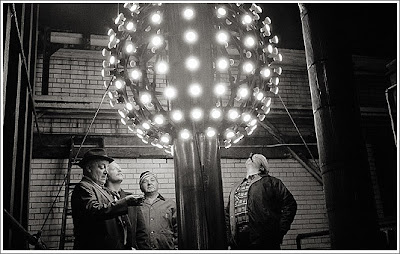
As most people know, even if they don't live in the United States, in America, one of our biggest celebrations for New Year's Eve is the ball drop in Times Square.

The original ball was dropped on New Year's Eve in 1907.

The ball was made of wood and iron, weighed around 700 pounds, and only measured 5 feet in diameter.


Now, if you know anything about the New Year's ball we currently have perched in Times Square, you couldn't help but notice that it has undergone some drastic changes for the better since 1907. It was replaced for the first of several times in 1920.It remained the same size of 5 feet in diameter, but was made only of iron, and weighed around 400 pounds.That ball stayed in use until the 1950s, when it was replaced for a second time with a ball made of aluminum, making it weigh a slight 150 pounds.
The year 1995 brought some interesting changes.Rhinestone and strobe lights were added to the ball.This was also the first year that the ball was lowered with computer technology.
A new ball was designed for the new millenium-radically different from the old ones.
This new ball measured 6 feet in diameter, weighed over 1,000 pounds, was covered in over 500 Waterford Crystal triangles, and was illuminated with 600 bulbs (both internal and external) plus strobe lights and spinning mirrors.
One thing I hadn't known before today, but I think is really neat, is that many of these triangles on the New Millenium ball were inscribed with messages like "Hope for Fellowship," "Hope for Wisdom," "Hope for Unity," etc. The New Millenium ball was used for 7 years.
Then, for the 100th anniversary of the ball drop, yet another ball was made.This ball was 6 feet in diameter, weighs 1,212 pounds, and was lit with LED lights. This fifth Centennial ball was used for only one year (which seems a little extravagant/excessive to me, but what do I know?).
It was then replaced by the ball we will be using tomorrow night.The same design was kept, but it was enlarged so that the current ball sitting in Times Square as I type is 12 feet in diameter, weighs over 11,000 pounds, and has over 9,000 bulbs that light it.This new ball is so much bigger and heavier that the flag pole it sits on had to be rebuilt to support it.


"Should old acquaintance be forgot
And never brought to mind?
Should old acquaintance be forgot
And old lang syne?
For auld lang syne,my dear,
For auld lang syne,
We'll take a cup of kindness yet,
For auld lang syne."

First verse and chorus to the song Auld Lang Syne, based off of a traditional Scottish poem.
The phrase "auld lang syne" translates to something along the lines of "old times," and is sung at many things that signify the ending of one chapter in life and the beginning of another, but is most widely known today for being sung at midnight on New Year's Eve.
Listen to the song here:


And, with that, I wish you a very safe and happy New Year's Eve tomorrow.
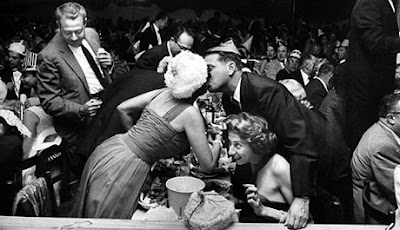
Celebrate it with people you love.
Here's to resolutions
hope for a new year
and hope that the New Year's Eve ball really doesn't get stuck halfway down the flagpole.
;)


"For last year's words belong to last year's language and next year's words await another voice."-T.S. Eliot

"Some people swear there's no beauty left in the world, no magic. Then how do you explain the whole world coming together to celebrate the hope of a new year?"-New Year's Eve, 2011