Lover of anything vintage.
I spend my free time looking at antiques,watching and collecting classic films,and reading some of the greatest literary classics known to man.This blog is just my way of sharing my interests with other people.
It is officially October, which many of us know as National Breast Cancer Awareness Month.
We decided that the best way to get back into blogging after being on hiatus, is by jumping in with a new special segment, which provides us with a chance to practice using our blogging muscles while simultaneously supporting a search for a cure.
This month, on October 10, 17, and 24, we are going to do special posts about the lives and collective works of three gorgeous and talented stars who lost their lives in the battle against breast cancer.
So celebrate life and the hope of finding a cure with us this month here at Think Classic.
And remember to Think Pink!
"I believe in PINK. I believe that laughing is the best calorie burner. I believe in kissing, kissing a lot. I believe in being strong when everything seems to be going wrong. I believe that happy girls are the prettiest girls. I believe that tomorrow is another day, and I believe in miracles."
-Audrey Hepburn
Keep checking back this afternoon and evening for our first Think PINK post!
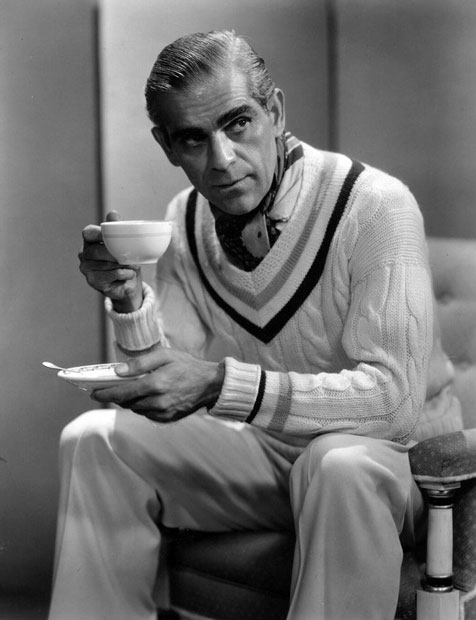
Welcome to another segment of Silent Saturdays! We're excited to share another wonderfully talented star with you today. The subject of today's post is well known to most people even today, for his trademark roles as a villain or antagonist. Many people do not realize, however, that his climb to fame began during the silent era.
Boris Karloff
Born November 23, 1887
Died February 2, 1969
A blue commemorative plaque marks the address where William Henry Pratt was born in Honor Oak, LDN, England in the fall of 1887. He was the youngest of 9 children, born into a family of rich Anglo-Indian heritage. He was also the great-nephew of Anna Leonowens, who was the inspiration for the famous musical The King and I.
Pratt's mother died when he was relatively young, and he was left in the care of some of his older siblings. He graduated from Merchant Taylors' School, and then went on to study consular service at King's College in London, but he never graduated. He decided to leave school in 1909 and began looking for work wherever he could find it. Many of the odd positions he found involved difficult manual labor, resulting in back problems that he struggled with for the rest of his life. During this time, Pratt almost accidentally stumbled into the world of acting, but it was clear that he had a peculiar gift. Not even a full year after he dropped out of school, he moved to Canada and changed his name to Boris Karloff. No one is quite sure where he came up with the name, but his reasoning for its change was quite clear. Most of his older brothers had prominent jobs in foreign services, and Karloff was afraid of letting them down or embarrassing them with his chosen career path. He believed this until he reunited with his family over 20 years later, at which time he was pleasantly surprised to discover that they were all immensely proud of him and his achievements.
After 2 years in Canada, Karloff became a part of the Jeanne Russell Company in 1911. He stayed with this group for at least a year. Moving on and looking for more work to support him, Karloff took on a job as a
baggage handler for a railway company. This eventually took him to Minot, North Dakota, where he was introduced to the Harry St. Clair Co. He joined up with them and spent another year performing in various roles in a sort of makeshift theater that was located in the upper story of a hardware store.
Eventually, Karloff found himself in Hollywood, and while there was work for him, he still did manual labor to get by in between parts. Several of his earliest roles were for film serials, such as The Lightning Raider (1918), The Masked Rider (1919), or The Hope Diamond Mystery (1921). He also had parts in iconic films such as the earliest on screen production of The Last of the Mohicans (1920). In his early days in the land of the stars, Karloff had yet to be cast into any of his monster roles. During the silent era, he was primarily used to portray dark and mysterious foreigners, or villains. His first talkie was Behind That Curtain (1929).
While people were familiar with Karloff, he didn't catch his first big break until he was cast as the monster in the movie Frankenstein (1931). Karloff was very lucky to get the part, and only did so because better known actors turned it down because it had no real speaking parts. The role was also very strenuous. The costume was heavy and bulking--especially the platform shoes that he was required to wear which weighed 11 lbs per foot. Heavy makeup was also a difficult and sometimes tricky prospect in those days, with the potential to be poisonous if too much of it was worn for too long. But Karloff took out life insurance for the project and endured the hours of preparation that turned him into the monster. His patience paid off, and the 1931 picture was an iconic success.
From that time, Karloff was offered better roles. He was the original Imhotep in the 1932 version of The Mummy, and also had a memorable part in the film Scarface later that year. While he certainly did not always play a monster, Karloff had found his niche with it. There were two sequels that gave him the opportunity to reprise his role as the Frankenstein monster, The Bride of Frankenstein (1935) and Son of Frankenstein (1939). He also returned to the story of Frankenstein later in life, but in a different role. He played the scientist both times with House of Frankenstein (1944), and Frankenstein 1970 (1958).
Karloff had many other important roles throughout the 1930s, such as The Raven (1935), The Black Cat (1934), and The Tower of London (1939). During the 1940s, Karloff dabbled with radio, even having his own anthology series called Starring Boris Karloff. It was also during the forties that Karloff took some time to pursue stage work on Broadway, which he loved. His first reappearance on the stage was in the original Broadway production of Arsenic and Old Lace in 1941--a role that he would reprise once more on screen in the course of his life. Other roles he had on stage were that of Captain Hook in Peter Pan, and a part in The Lark, which he would also reprise later on for television.
Moving into the 1950s, Karloff took on a television role in the British series Colonel March of Scotland Yard. He became a regular on TV segments such as NBC'sWho Said That?, and The Red Skelton Show. He continued to work on many different projects until the end of his life, despite having one of his lungs removed and having to use oxygen between takes. Perhaps one of the pieces of his later work that he is most recognized for is using his voice talents for the main character and narration of the 1966 special How
the Grinch Stole Christmas.
Despite being known for his villainous roles, Karloff was reportedly a very kind and generous gentleman. He invested much of his time and money in charity work, especially anything that helped children. In 1940 he dressed up as Father Christmas and handed out presents in the children's ward of a hospital in Baltimore, Maryland--a tradition that he carried out every year as long as he was physically able. He was a devoted father to his own daughter, Sara Karloff, who was born during the filming of Son of Frankenstein, which resulted in Karloff rushing to the hospital in his full costume at the time of her birth.
Towards the end of his life, Karloff moved back to England full time, spending the rest of his days in his home, known as Roundabout Cottage. He struggled with severe arthritis as well as emphysema. He contracted pneumonia and died due to complications on February2, 1969, at the age of 81.
Boris Karloff had a remarkable career in many different genres. He left his mark in the worlds of television, radio, and of course film. Over the course of his career, he made 162 motion pictures, 56 of which were silent films from the early days of his career. Amazingly, he never received any awards for his work, but that makes it no less important or remarkable.
"One always hears of actors complaining of being typed--if he's young, he's typed as a juvenile; if he's handsome, he's typed as a leading man. I was lucky. Whereas bootmakers have to spend millions to establish a trademark, I was handed a trademark free of charge. When an actor gets in a position to select his own roles, he's in big trouble, for he never knows what he can do best. I'm sure I'd be damn good as Little Lord Fauntleroy, but who would pay ten cents to see it?"
-Boris Karloff
"My dear old monster..I owe everything to him. He's my best friend."
-Boris Karloff
"You could heave a brick out of the window and hit ten actors who could play my parts. I just happened to be on the right corner at the right time."
As we have specified to our readers before, we here at Think Classic are from the good ole US of A. Therefore, as many of you will know, today is a very important day for us. It is important to us to do even some small post in honor of those who sacrifice for us in order to give us our freedom on this Memorial Day.
So take a little time to reflect on the significance of this day before you go out and have some fun on the lake or at a cookout. And if you know somebody who serves, be sure to thank them.
"Bent double, like of old beggars under sacks,
Knock-kneed, coughing like hags, we cursed through sludge,
Till on the haunting flares we turned our backs
And towards our distant rest began to trudge.
Men marched asleep. Many had lost their boots
But limped on, blood-shod. All went lame; all blind:
Drunk with fatigue; deaf even to the hoots
Of tired, outstripped Five-Nines that dropped behind.
Gas! Gas! Quick, boys!-An ecstasy of fumbling,
Fitting the clumsy helmets just in time;
But someone still was yelling out and stumbling,
And flound'ring like a man in fire or lime...
Dim, through the misty panes and thick green light,
Welcome to the second installment of Silent Saturdays, but most importantly, welcome back to Think Classic! We sincerely apologize fore being so useless and silent for the last few months. We are looking forward to getting back into the swing of things, starting with this post!
Today we are honoring a radiant jewel who still holds her luster from the silent era, despite the fact that she so often gets overlooked due to unfortunate circumstances at the time of her career.
Marion Davies
Born January 3, 1897
Died September 22, 1961
Marion Cecilia Douras was born in Brooklyn, New York in the winter of 1897. She was the youngest of five children--four daughters and one son, born to Rose and Bernard Douras. Marion's father was a judge in New York City. She came from a respectable family, but as she and her sisters grew older, they all willingly changed their surname to "Davies." One of the girls had seen the name on a real estate sign and they felt that it might be helpful in their future careers to be represented by a name that alludes to British ancestry. The Davies family was very religious, and all of the children were educated in a private state convent. Eventually, Marion decided that her goals lay beyond the realm of academic achievement, so she left school to build her career.
Davies soon found work as a model and she had several jobs posing for different artists and magazines. At the age of 18 she became one of the infamous Ziegfeld girls and joined up with the Ziegfeld Follies. It was later that same year that her modeling career landed her in front of a different kind of camera. She was chosen to model gowns by designer Lady Duff-Gordon on a newsreel. The next year, Davies appeared on the screen in the film Runaway Romany (1917), which she was also privileged enough to be able to take part in behind the scenes. Davies actually wrote the film herself, and was allowed some creative license due to the fact that the renowned director, George W. Lederer, was her brother-in-law. Critics and audiences alike seemed to automatically take a liking to this beautiful new talent--they wanted to see more of her.
And so they did. She starred in three different films in 1918--The Burden of Proof, Beatrice of Fairfax, and Cecilia of the Pink Roses. These roles turned out a good profit for Davies, who led a comfortable lifestyle. She was also always very generous with her earnings, and used them to help out her family and friends in any way she could. As time went on, she would also prove to be a very astute businesswoman with investments and donations.
In 1917, Davies became romantically involved with newspaper mogul William Randolph Hearst, who played an interesting part in her career. The two apparently truly cared for one another, and yet they were often at odds within their relationship. Hearst genuinely wished to further Davies in her career, but thought that she would excel in elaborate and expensive costume dramas, rather than the lighthearted comedies that suited her so much better. This difference of opinion might not have been so significant had Hearst not had the financial means to so thoroughly manage her career. As it was, he took it upon himself to relentlessly promote her in the papers, and would even step in and fervently insist that she be given specific roles. No one refused him. In 1918, Hearst outdid himself when he opened his own studio called Cosmopolitan Productions, with the sole intent of using it to bolster Davies' career. Certainly the publicity played its part, and Davies was very quickly becoming one of the most promising stars in the industry.
As time went on, most people began to take note of Davies for other reasons. The lavish
lifestyle she lived, largely due to Hearst, escaped nobody's notice. In all of the years that she spent with Hearst, she never complained about the way that he managed things. It was not until much later in her life that she admitted via her memoirs that he ended up playing a part in the downfall of her career. She seemingly gladly accepted the roles that Hearst placed in front of her, which cast her as more elegant and dramatic characters. But Hearst could never completely eliminate her natural bend for comedy. As Davies rubbed shoulders with Hollywood's most elite, many people could not help but notice her gracious and amusing personality which allowed her to shine as the center of attention at any social gathering. Directors such as King Vidor did their best to tap into her true personality for the roles that they gave her in more contemporary comedies such as Not So Dumb (1930), or The Patsy (1928).
Many of the high points of Davies' career in film happened before talkies dominated the big screen. Davies was apprehensive with the developments of microphones which would enable people to hear her speaking voice, since she had never fully recovered from a stutter since childhood. She was one of the lucky ones, however, who managed a relatively smooth transition and was therefore able to continue on in her career. She did well in the early 1930s, finding herself cast alongside the likes of Leslie Howard, Clark Gable, Bing Crosby, and Gary Cooper in such pictures as Five and Ten (1931), Polly of the Circus (1932), Going Hollywood (1933), and Operator 13 (1934).
The relief that came after her transition to talkies at the beginning of the 1930s was short-lived. In another attempt to steer her away from comedy, Hearst tried to cut a deal with producer IrvingThalberg. He wanted Thalberg to cast Davies as the lead in the epic drama Marie Antoinette. Thalberg ended up giving the famous part to his own wife, actress Norma Shearer. Davies, who was good friends with the Thalbergs at the time, had no objection to this decision. Hearst became angry and severed all ties with Thalberg and publicly pulled his support from MGM--a fatal move for Davies' career. He instead moved Cosmopolitan Productions to team up with Warner Brothers. Davies made only three more pictures under these new arrangements before Cosmopolitan folded. She then made the decision to retire from the film industry, knowing that after the last 20 years, she had done all she could. She devoted herself to caring for Hearst for the next decade, until his death in 1951.
Later in 1951, Davies moved on and married Horace Brown. It was a tumultuous marriage, but the couple remained married until her death. She spent the rest of her life tirelessly doing charity work, founding the Mattel Children's Hospital and the Marion Davies Foundation to fight children's diseases. Marion Davies struggled with various illnesses and injuries in her older age, and she eventually succumbed to stomach cancer on September22, 1961 at the age of 61.
About 30 years after her death, Davies' niece, Patricia Lake died from lung cancer. Just after her death, a secret was broadcast which Lake had kept to herself since she was 17--that she was not, in fact, Davies' niece, but her daughter. Davies became pregnant in the early 1920s and Hearst sent her to Europe until the baby was born. They decided to give the baby to one of Davies' sisters who had recently lost a child in infancy, so that she could raise her as her own. So Patricia was raised as Davies' niece, despite the fact that she looked remarkably like Marion and spent most of her time with her and Hearst. Davies and Hearst privately passed on the finances to make sure that Patricia received the best possible care and education, and it was even the two of them who gave her away at her wedding, which was also the time when Hearst finally told her that they were her parents.
It was a scandalous piece of news that shocked many, especially since it had been kept a secret for so many years. But it is not the only thing that Davies is remembered for. Her work has stood the test of time. Although Hearst may have prevented her career from fully developing to the heights that she was capable of reaching during her lifetime, she still made her mark on Hollywood. During her 20 year career in the film industry, she starred in 55 motion pictures, 34 of which were silent. She made a name for herself, especially during the first part of her career which developed during the silent era. Audiences and critics today still look back at her work and are drawn to her talent just as they were 95 years ago--they want to see more of her.
"Somebody told me I should put a pebble in my mouth to cure my stuttering. Well, I tried it, and during a scene I swallowed that pebble. That was the end of that."
-Marion Davies
And now, as a little something extra which allows you to see an example of Marion Davies' comedic talents. This is a clip from her 1928 silent film The Patsy. Davies was known for her party impersonations of other actresses. In these scenes, King Vidor allowed her free reign to act out her own imitations of actresses Mae Murray, Lillian Gish, and Pola Negri:
This is just a fun post for me, today. As any one of my friends or family members would attest, my favorite band is Queen. Along with many others, I was watching American Idol last night and I had to chuckle a bit when one of the contestants was described as something like Freddie Mercury's lovechild from Woodstock.
So, then I was talking about him and Queen with one of my family members afterwards and I realized that I could most definitely do a post about him on Think Classic, partly because he was a classic rock musician, and partly because I'm the head author so I can do whatever I please.
Freddie Mercury
Born September 5, 1946
Died November 24, 1991
The man that the world knows as "Freddie Mercury" was actually born Farrokh Bulsara in Zanzibar to Parsis parents, Bomi and Jer. There are many people who also do not know that he had a younger sister named Kashmira. Farrokh displayed a keen interest in music during his childhood, so his parents gave him piano lessons while he was in elementary school. He was sent to an all boys boarding school in Bombay in 1954, and it was here that his musical talents truly thrived. He had a musical ear, and could play back almost anything on the piano after hearing it on the radio. By the age of 12 he put together his own band with some of his schoolmates. It was as he began to perform with his band and sometimes on his own, that he decided to start going by the name of Freddie. After graduating from school he returned to his family in Zanzibar.
They did not remain there for long, however. The Zanzibar Revolution began in the 1960s, and Freddie and his family left the country for their own safety, eventually settling in Middlesex, England. Shortly after that, Freddie decided to enroll in what is now West Thames College of West London. He received a degree in art and graphic design.
After his graduation, Freddie worked various different jobs to get by while he tried to start a musical career. He worked at Heathrow Airport, and spent much of his free time selling clothes in the Kensington Market with his girlfriend, Mary Austin, whom he had met through his good friend and guitarist Brian May.
Finally, in 1970, Freddie (who had now officially adopted the surname of Mercury), Brian May, and one of May's previous bandmates, Roger Taylor, teamed up to create a band of their own. Freddie drew the logo for the new band himself, but when the question arose of what they would call themselves, Freddie boldly picked out a name the others did not feel comfortable with. Freddie persisted and won out, and Queen was formed.
As a band, Queen broke musical boundaries, and wrote some of the best remembered songs of their time. Queen was cutting edge, in every way, and many would say that is due to Freddie. He spent much of his time writing original songs, and his lyrics were cultural, diverse, eloquent, and creative. He also wrote the songs to fit into many different genres like gospel, disco, progressive rock, heavy metal, and many more. During concerts, Freddie never failed to put on a show. He was highly theatrical, always made a point of interacting and connecting with the crowd, and he became known for his flamboyant costumes. He was his very own enigma--always shocking and doing something different, creative or unique, yet at the same time always becoming what the audience wanted. The audience's love made him come alive into an extreme extrovert, that was far from his true off-stage personality.
Whilst continuing to work with Queen, Freddie also made the decision to branch out on his own. As a solo artist, he produced two studio albums, released 3 years apart. The first, Mr. Bad Guy (1985), was a more fun album with dance music. The second, Bacelona (1988), was to many a baffling combination of some of the more popular genres of the day and opera music. Even though neither album rated as high as any of the albums he made with Queen, they were still successful, especially in the UK.
Freddie was intensely private when it came to his personal life, but when he did speak about it, he was open about his bisexuality. He also spoke about his love for long-time girlfriend, Mary Austin, who was the love of his life even after their relationship ended. He also said that she was his only friend, and several of his songs allude to her.
In the spring of 1987, Freddie was diagnosed with AIDS. He did not want the public, especially his fans, to be made aware of his condition, even stating in one of his rare interviews that he tested negative. Despite his success in keeping it a secret, rumors began to spread because of his physical appearance. As time went on he became shockingly thin and gaunt. He stopped working with Queen in the summer of 1991, and then retreated to his home and privacy. Mary Austin came to visit and care for him regularly as his illness progressed. Eventually he reached a low point where he became bedridden and his eyesight began to fail. Miserable, he made the decision to go off his medication. In November of that year, he arranged for a public statement to be released, in which he finally acknowledged his illness to the public, pleading for his privacy to continue. Almost exactly 24 hours after that statement was released, Freddie Mercury died on November 24, 1991. He was 45 years old. Raised in the Zoroastrian religion, he remained devout throughout he life, and a priest conducted his small and private funeral. It is believed that the only person who knows where his ashes were put to rest is Mary Austin, who was granted his estate in his will, which is where she still resides today.
Freddie Mercury once said that he wanted to be a legend. Throughout his career he released 17 studio albums, including the two he put out as a solo artist. He is still remembered and well known all around the world today. There are statues, plaques, and other various tributes to him in many different countries. He has been ranked as one of the greatest rock singers of all time. I think it is safe to say that he got his wish.
"I won't be a rock star. I will be a legend."
-Freddie Mercury
"When I'm dead, I want to be remembered as a musician of some worth and substance."
-Freddie Mercury
If ever I had to choose one song that perfectly described Queen in it's style, genre, content and energy, it would be one of the singles from their 1979 album Jazz, entitled Don't Stop Me Now:
It's finally here! The first segment of Musical Mondays!
And we're so glad that you're here to join us.
We figured that for our first segment ever, we would just jump right in with one of our favorites,
so without further ado...
My Fair Lady
1964
Starring Audrey Hepburn, Rex Harrison, Wilfrid Hyde-White, Stanley Holloway, and Gladys Cooper
In 1964, yet another film adaptation of the famous play Pygmalion by George Bernard Shaw was released. Though under the different name of My Fair Lady, it tells the same story with the same beloved characters.
Set in the early 1900s, My Fair Lady is about a young Englishwoman who struggles with her social status since she is poor and has a Cockney accent. One evening, a man by the name of Professor Henry Higgins (Harrison), a teacher in diction and elocution who possesses a very short temper, is accompanied by a friend named Colonel Hugh Pickering (Hyde-White), who is also a phonetics expert. The two of them are standing out in the open, discussing their similar interests when Professor Higgins voices his opinion that the only thing that truly determines one's place within society is the way they speak. Colonel Pickering, disbelieving, is assured by Professor Higgins that he could take any common girl off the street and give her lessons so that in time she could be passed off as "a duchess at an embassy ball." Enter Eliza Doolittle (Hepburn). To prove that he is not joking, Professor Higgins singles out Eliza who has a particularly bad Cockney accent. When he tells her what he and the Colonel are discussing, she also thinks he is mad. Plus she is too proud to accept his help, which suits Professor Higgins just fine because he was just pointing her out as an example.
Yet, even after Eliza has parted ways with the two gentlemen, she cannot seem to get the idea out of her head...She is a respectable girl who just has an unfortunate accent. But if Professor Higgins was telling the truth, then she could go to him for lessons and finally get a proper position instead of just selling flowers on the street. She decides to approach Professor Higgins in the hopes of taking him up on his offer. She dresses in her shabby best and makes her way to his house. Eliza tells him that she is a respectable girl who wishes to have speaking lessons and is willing to pay for them. Professor Higgins attempts to brush her aside, not having the time or the patience for her and her pittance of one shilling per lesson, but she refuses to leave. Finally, Colonel Pickering, who is staying with Professor Higgins for the time being, accuses Professor Higgins of not wanting to teach the girl because he thinks he can't do it. So, he offers to pay for Eliza's lessons himself, and encourages Professor Higgins to take the offer. Higgins, insulted that the Colonel thinks he could not make good his boast, finally agrees.
From that time on, Eliza moves into Professor Higgins' house. Day and night, the relentless professor makes her slave away with exercises to improve her speech. She speaks into a recorder for hours pronouncing her vowels, tries to speak with marbles in her mouth in order to enunciate, spends her evenings trying to say little ditties like, "the rain in Spain stays mainly in the plain" to further help with her vowels, or "how KIND of you to let me come" to teach her inflection. She spends most of her days in tears because Professor Higgins is so harsh with her. All three of them--Eliza, Professor Higgins, and Colonel Pickering--are beginning to feel utterly hopeless about the whole idea one evening when finally, finally, Eliza understands. Everything just sort of clicks in her brain and she begins to speak properly.
Eliza keeps working and practicing, and therefore improving. Professor Higgins decides to take her for a "test run," so to speak, and tells her she is going to Ascot to see how she does in public with real members of the upper class. Colonel Pickering pulls out all the stops and makes sure she is dressed for the part. On the day of the event, it is obvious that she still needs to practice, yet she makes a favorable impression with everyone present until she gets caught up watching the race and shouts, "Come on, Dover! Move yer bloomin' arse!" Professor Higgins and Colonel Pickering take her home to continue to work so that she will be ready for the embassy ball.
The evening of the ball comes and it is evident that Eliza has undergone a complete transformation. She is beautiful, with the manners of a genteel upper class woman, and a speaking voice to match. Higgins and Pickering take her to the ball and everyone there is intrigued by her. She is a big hit, and even dances with a prince from another country. Professor Higgins and Colonel Pickering are relieved that she is doing so well. They have a slight moment of tension when she begins to dance with a foreign phonetics expert. However, once the expert says that he is sure that she must be a foreign dignitary of royal blood, Professor Higgins is over the moon. He is ecstatic and when they arrive back at the house late in the evening, he is in a celebratory mood. Eliza, however, is not. She is hurt and frustrated that all of the credit is going to Professor Higgins, while no one shows any appreciation for her or the hard work and effort she put into her lessons, nor her dedication to learn. In fact, Professor Higgins is just as harsh to her after her accomplishments as he was before. The two of them argue, and she walks out on him.
At first, Eliza returns to her home, but she realizes that with her new speaking voice, education and wardrobe, she does not belong there anymore. Not knowing where else to go, Eliza goes to the home of Henry's mother, whom she met at Ascot. Professor Higgins follows her there and the two have a confrontation that does not end well, as she walks out on him again. Professor Higgins returns home telling himself that it's of little to no importance because she's bound to come crawling back to him after all that he has done for her. But as he is faced with the silence of his big, empty house, he comes face-to-face with the realization that it is of great importance to him whether or not she comes back, because he actually cares for her. What if it wasn't an empty threat? What if she really never did come back and he never saw her again? Just then, Eliza surprises him by walking into his study.
"Eliza, you are to stay here for the next six months learning to speak beautifully, like a lady in a florist's shop. If you work hard and do as you're told, you shall sleep in a proper bedroom, have lots to eat, and money to buy chocolates and go for rides in taxis. But if you are naughty and idle, you shall sleep in the back kitchen amongst the black beetles, and be walloped by Mrs. Pearce with a broomstick. At the end of six months you will be taken to Buckingham Palace, in a carriage, beautifully dressed. If the king finds out you are not a lady, you will be taken to the Tower of London where your head will be cut off as a warning to other presumptuous flower girls! But if you are not found out, you shall have a present of...ah...seven and six to start life with as a lady in a shop. If you refuse this offer, you will be the most ungrateful, wicked girl, and the angels will weep for you."
-Professor Henry Higgins
My Fair Lady is a wonderful, fun musical full of humor and a tiny hint of romance. It was nominated for 12 Oscars and won 8 including the Academy Award for Best Picture, and the Academy Award for Original Music Score. If you aren't really accustomed to watching a musical, then we think My Fair Lady would be a perfect starting point.
We will be posting musical tracks from the motion picture on our Facebook page later this evening:




.jpg)


