About Me

My photo
Lover of anything vintage. I spend my free time looking at antiques,watching and collecting classic films,and reading some of the greatest literary classics known to man.This blog is just my way of sharing my interests with other people.

Monday, September 10, 2012

"I am not a has-been. I am a will-be."

STAR OF THE MONTH
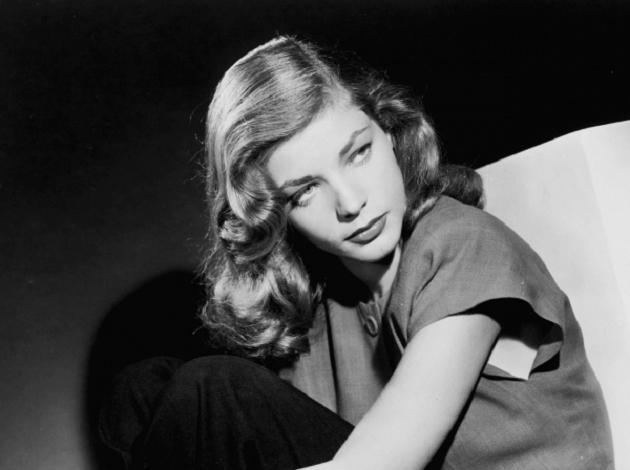
Lauren Bacall
Born September 16, 1924
Betty Joan Perske was born to Jewish immigrants, Natalie Weinstein-Bacal and William Perske, in the Bronx, New York, 1924.  When she was only 5 years old, her parents divorced and she never kept in contact with her father.  She did, however, have a very close relationship with her mother throughout her life.  It was after her parents' divorce that her mother, Natalie, changed her last name to the Romanian form of her maiden name, Bacall, which Betty would later also adopt as her surname.
As a teenager, Betty Perske, now going by Betty Bacall, enrolled in the American Academy of Dramatic Arts.  In order to pay for school, Bacall worked as a theater usher.  Later on, she began to test the waters in the world of modeling, and it was due to these jobs that she got her big break.  In 1943, the wife of film director Howard Hawks saw Bacall on the front of Harper's Bazaar Magazine.  She approached her husband about this new, attractive, striking face and convinced him to contact her and invite her to do a screen test for the upcoming film To Have and Have Not (1944).  Hawks not only had Bacall audition for the film, but was so impressed with her that he moved her out to Hollywood, signed her to a seven year contract, and began paying her $100 a week.  Essentially, Hawks took on the role of manager for the new, young actress.  His wife, Nancy Hawks, helped train her in other ways, making sure she was always dressed in the latest fashions, and teaching her other little graces and types of etiquette.  It was during this time of transition that Bacall (now officially renamed Lauren by Hawks) developed two of her biggest career trademarks.  She was formally trained to speak in a slower, deeper, more masculine tone of voice, which she later on became known for.  She also developed her trademark known as The Look, where she would angle her face downwards and look up at the camera through her lashes.  Believe it or not, The Look was developed out of nerves, but it worked.
It was also during the filming of To Have and Have Not that Bacall met Humphrey Bogart for the first time.  Though he was 25 years her senior, the two fell head-over-heels in love and began an affair.  It was a well-publicized relationship, with the public affectionately referring to the couple as "Bogie and Bacall."  They married in 1945, when Bacall was 20 and Bogart was 45, and they remained married until 1957, when Bogart died after battling esophageal cancer--a hard loss for Bacall, who later said,
"A man's illness is his private territiory and, no matter how much he loves you and how close you are, you stay an outsiderYou are healthy."

Bacall worked on several more films in the latter half of the 1940s, including Confidential Agent (1945), The Big Sleep (1946), and Dark Passage (1947).  Her trademarks helped her create an on-screen persona that made her stand out in the film noir genre.  But Bacall also played notable parts in other genres as well, such as the comedy How to Marry a Millionaire (1953), and the 1950 film Young Man with a Horn, which is considered to be one of the first big-budget jazz films.
Bacall has had a brilliant and full career, starring in over 60 productions, including television appearances, Broadway, documentaries, etc.  She has been nominated for numerous Golden Globe, BAFTA, and SAG awards over the years, and was chosen to receive an honorary Academy Award for her achievements in film in 2009.  She is still active at 87 years old.

MOVIE OF THE MONTH
Designing Woman
1957
Starring Lauren Bacall, Gregory Peck, and Dolores Gray

A sports journalist by the name of Mike Hagen (Peck) goes on vacation and meets elite fashion designer Marilla Brown (Bacall).  Despite having almost nothing in common other than being living, breathing human beings, the two decide to get married before anyone (including themselves) really knows what's going on.  Reality starts to hit when the newlywed couple returns to New York and tries to mesh their separate lives together--Marilla being dunked into a world of sports-crazed men, and Mike being looped into a life that revolves around clothes and the elite, dramatic, high-fashion social circle of his new wife.  Their differences are further underlined after it is decided that Mike will move into Marilla's East Side apartment.  Marilla goes to her husband's old bachelor pad and discovers not just that he has a poor sense of style, but also a picture of actress Lori Shannon (Gray)--Mike's ex-flame.  She tells herself that it surely means nothing, and tries to disregard it yet, as time goes on, she feels like Mike is keeping a secret, and she begins to fear the worst.
Mike certainly is keeping a sercret--but it's not at all what his wife thinks!  He has recently run into a bit of trouble by exposing boxing promotor Martin J. Daylor as a crook and a fraud.  Mike is informed by his co-worker that Daylor has been snooping around, leaving messages, and making threats on Mike's life.  But Mike doesn't wish to alarm or scare off his new wife, who is not accustomed to his lifestyle, so he decides that it is knowledge that Marilla does not need to be burdened with.  Things get sticky as time goes on--Marilla just gets more suspicious that Mike is having an affair with Lori Shannon, which is only made worse when Mike has to go into hiding, pretending to be travelling with a sports team, yet none of the stories he tells his wife over the phone seem to match up.
Things just continue to slide downhill until everyone--Mike, Marilla, their friends, Daylor and his cronies--end up in a back alley and fight it out.  But all ends well when Mike is forced to defend Marilla and the two of them realize that, even with all their differences and misunderstandings, they got married for a pretty good reason--because they love each other.


This comedy of circumstances was directed by Vincente Minelli, and the film did incredibly well at the time of its release.  Bacall and Peck had excellent on-screen chemistry, and it was one of those rare movies for Bacall that brought out her witty side and hilighted her comedic talents.

You can catch Designing Woman starring Lauren Bacall on Turner Classic Movies on Wednesday, September 19, at 3:45 am ET.


"I used to tremble from nerves so badly that the only way I could hold my head steady was to lower my chin, practically to my chest, and look up at Bogie."

"You can't start worrying aout what's going to happen.  You get spastic enough worrying about what's happening now."

"I think your whole life shows in your face, and you should be proud of that."

Saturday, September 8, 2012

"Why do you want to live?"

Fall of '48 post #1
The Red Shoes
September 6, 1948
Starring Moira Shearer, Anton Walbrook, and Marius Goring
A talented but undiscovered ballet dancer by the name of Vicky Page (Shearer) gets her big break and sets her career in motion when she meets the ruthless but extraordinary director Boris Lermontov (Walbrook) at a small after party for one of her dance recitals. Lermontov watched her dance and was somewhat impressed, so approached her afterwards. By talking to Vicky, he learned what true passion she had for dance--that it didn't matter to her who she danced for, whether she was famous or got paid for it, but that the only thing that mattered was that she simply dance, because she loved it so much. After that night, Lermontov decides to take her on and train her as one of his pupils. He never truly realized her potential and her gift until he watched her perform a part in Swan Lake.  Lermontov then approaches Vicky and tells her how impressed he is with her and extends an invitation for her to accompany his studio to Paris.
While in Paris, the star prima ballerina of Lermontov's company makes the decision to try and balance a personal life and her career, so she gets married--a choice that Lermontov finds infuriating and unacceptable. He makes the clear statement in front of all of his dancers saying, "A dancer who relies upon the doubtful comforts of human love will never be a great dancer. Never." And from that time on, he begins to take a new interest in Vicky, believing that she would make an excellent replacement and lead dancer. So, he has Julian Craster (Goring) create a new dance called The Red Shoes, and everything revolves around Vicky--his new rising star. Unbeknownst to anybody else, Vicky and Julian fall in love and begin an affair while working together on The Red Shoes. Their secret is safe for a while, but eventually Lermontov discovers that the two are lovers and he is furious. He approaches Julian and reprimands him for the affair--for tampering with Vicky's career--and he demands that the two no longer see eachother. When Julian refuses, he is fired from the company. Lermontov believes that will solve the problem, but Vicky and Julian are in love, and when she learns that Julian is leaving the company, she goes with him. Lermontov frees her from her contract, and the two lovers move to London where they get married and live quite happily together.
Some time later, Vicky goes on a vacation to Monte Carlo, and whilst travelling is approached by Lermontov, who begs her to return to the company just to perform in a revival of The Red Shoes. She agrees, but on opening night, while Vicky and Lermontov are backstage, Julian appears wanting to take her home, because he wants to keep her safe from the destructive lifestyle of Lermontov. Julian and Lermontov go head to head, and Vicky, emotionally torn between her love for her husband and her love of dance, does not know what to do. Yet since she did not automatically choose to go with Julian instead of stay and dance with Lermontov, Julian believes he has lost her, so he leaves them to go to the railway station.
While standing in her costume backstage, Vicky realizes that she can dance anywhere and under any circumstances to get enjoyment out of it, but she will never be happy without Julian so she runs out of the theater and to the railway station to stop him from leaving. Julian is on the platform, waiting to board his train when he sees Vicky running. Desperate to reach him, she climbs over a balcony, but falls out onto the track in front of the oncoming train. Vicky dies, and Lermontov is shocked to hear the news almost instantaneously back at the theater. He goes out in front of the audience and tells them of the tragic accident. But the show must go on, so The Red Shoes is performed as scheduled, but where Vicky would be dancing on stage, there is only an empty spotlight.

The musical drama The Red Shoes was released on September 6, 1948, making it our first movie to help us get in gear and go back in time to the fall of 1948. The film was a success, grossing five million dollars at the box office. Moira Shearer, the star of the film who plays Vicky, made her film debut in The Red Shoes. She was an internationally famous ballet dancer from Scotland, and (in case you were wondering) was of no relation to Canadian actress Norma Shearer.

That is all of the first post of Fall of '48.
We'll see you next week, but in the mean time,
don't forget to:
Follow us on Twitter: @Think_Classic


"Lermontov: Why do you want to dance?
Vicky: Why do you want to live?
Lermontov: Well, I don't know exactly why but...I must.
Vicky: That's my answer too."


Saturday, August 11, 2012

"The only way to enjoy anything in life is to earn it first."

In honor of Turner Classic Movies' Summer Under the Stars,
Think Classic now presents...


Ginger Rogers
Born July 16, 1911
Died April 25, 1995

Virginia Katherine McMath was born in July of 1911 to William and Lela McMath. Her parents had a troubled marriage, and when Virginia was very young they separated. They had a custody battle over her, until her mother Lela won all rights. Their divorce was then finalized, and Virginia relocated to Kansas City, MO with her mother, in order to move in with her grandparents. Virginia spent much of her time with her grandparents during her formative years, and was extremely fond of them throughout the rest of her life, even purchasing a home for her grandfather in California later on, so that they could be close to each other while she was working. It was undoubtedly while living with her grandparents that Virginia underwent the first phase of her name-change. She had a younger cousin who had trouble pronouncing her name and ended up calling her "Ginga." In 1920, Ginger's mother, Lela remarried and relocated the little family to Texas. Ginger took on her stepfather's last name of Rogers, even though he never actually adopted her--thus her official stage name of Ginger Rogers was developed.
It was also in her early formative years that Ginger was exposed to acting. Her mother had a love and appreciation for it, and even worked as a Hollywood script writer for a time. Her mother's close contact and interactions with the world of theater inspired Ginger when she was in high school.
While living in Fort Worth, Texas, Lela Rogers became a theater critic, and her daughter Ginger would often spend many evenings hanging around backstage at the theater. Eventually she developed friendships with some of the actors and they noticed her talent, so she began participating in smaller song and dance numbers in front of the audience. A lucky thing, too, because that was one of the first steps to launching her career.
Sometime around 1926-7, a travelling vaudeville act was rolling through Fort Worth and needed a temporary stand-in for one of their performances. Ginger was recommended for the job, and they were so impressed with her dedication and talent that it ended up opening quite a few doors for her. After winning a Charleston Dance contest, she went on a musical-dance tour for six months. Rogers was quickly becoming a bright new light on the stage.
Her mother acted almost as a manager, and accompanied Ginger on her tours. Eventually the tour landed them in New York City, where they decided to take their chances and stay. For a while, Rogers worked some smaller jobs for radio programs and broadcasts. In 1929, she made a huge career move when she auditioned and got the part for a Broadway musical called Top Speed. Producers were sitting up straight and taking notice. The musical had barely been open on Broadway for a couple of weeks when she was offered a leading role in another, entitled Girl Crazy. She accepted, and it was while working on Girl Crazy that she first met Fred Astaire, who had been hired to choreograph the dancers. The chemistry was instantaneous.
Rogers was only 19 when she starred in Girl Crazy, yet she instantly caught the eye of Hollywood's Paramount Pictures, who didn't hesitate to offer her a seven year contract.
Rogers didn't stay with Paramount for the full seven years. She made five motion pictures with them and then managed to get out of her contract early. She officially moved to Hollywood, after which she made three films with Pathe Exchange, and floated from Warner Brothers, Monogram, and Fox, all before the year of 1932. Eventually she began working with RKO Radio Pictures. It was working for RKO in 1933 that she crossed paths with Fred Astaire once more, making their first movie together, Flying Down to Rio.


Rogers and Astaire's first picture together was so successful that they made nine more while at RKO. Audiences fell in love with them, no matter what roles they were playing--fell in love with their elegant, intriciate dance numbers and their sometimes crazy, original songs. Throughout their partnership, which was one to go down in cinematic history, they filmed 33 major song and dance numbers together. But by 1940, RKO was facing financial troubles, and with those troubles came the realization that Rogers and Astaire could not go on together forever. They attempted to make a couple more pictures together for the studio, which weren't even half as successful as their earlier films. This just underlined the shared opinions of all involved that it was time to say goodbye.
But Rogers' career was far from over. She began to make solo appearances and prove her worth to Hollywood studios and producers, showing that she could be just as successful in multiple genres--she could hold her own. She displayed her comedic talents in blockbuster hits such as Tom,Dick,and Harry (1941), Bachelor Mother (1939), and The Major and the Minor (1942). She also proved how adept she was in more dramatic and demanding films, such as Primrose Path (1940), Stage Door (1937), Roxie Hart (1942), and her very famous role in Kitty Foyle (1940), for which she won an Academy Award.
Rogers was enormously successful in the realm of Hollywood's elite. She was lifelong friends with famous names of the day such as Lucille Ball and Bette Davis. She also had well publicized marriages to noteable names such as Jack Pepper, Lew Ayres, Jacques Bergerac, and William Marshall. She was honored with a star on the Palm Springs Walk of Stars in 1992. Throughout her brilliant career she starred in 73 motion pictures.
Rogers remained active and made public appearances until she began developing health problems which confined her to a wheelchair a few years before her death. Ginger Rogers passed away at the age of 83 due to heart attack.

Summer Under the Stars Movie Pick


Bachelor Mother
1939
Starring Ginger Rogers, David Niven, and Charles Coburn

A single woman by the name of Polly Parrish (Rogers) is living in NYC and working for a large department store. She was only hired to help out with the pre-season Christmas rush, and as Christmas approaches she is informed that they will be letting her go as soon as the holidays are over. Polly is outside on a break when she sees a woman leaving her baby on the steps of an orphanage across the way. This is none of Polly's business and she undoubtedly would have thought nothing of it, accept that after the mother leaves, she notices that the baby is about to roll off the steps and into the street. Feeling she can't let that happen no matter how dispirited she is towards her fellow man, she runs to pick up the baby. Just as she does so, the orphanage door is opened and the woman in charge assumes that Polly is the baby's mother. Try as she might, Polly just can't convince the woman that she is not the mother of this child. As she is arguing with the woman who runs the orphanage, the wealthy, playboy son of the department store owner, David Merlin (Niven) is passing by. He observes the trouble and tries to help. Polly insists that she couldn't keep this baby even if she was it's mother because she is soon to be out of a job and wouldn't be able to support it.
David feels badly for the supposedly delusional single mother. After learning that Polly works for his father's department store, he goes directly to his father, J.B. Merlin (Coburn) and arranges that he let the lady keep her job. Before Polly knows what's even happening she is told she may keep her job, gets a pay raise, and is sent home with her son. Her landlady is also sympathetic and agrees to provide childcare while Polly goes to work each day. Nobody will believe that she is not the biological mother of the child, so she finally just gives up and takes care of the baby, knowing that without her, he would just be stuck in an orphanage.
David checks in quite regularly to see how Polly and the baby are getting along, and to make sure that they have everything they need. The two become friends, and after a while, David develops feelings for Polly and her infant son. Feeling that his father would be furious about the match, however, he tries to keep their relationship private. On New Years Eve, David finds himself dateless for a grand party he is supposed to go to, so he asks Polly to go along, dressing her up in the finest clothes money can buy. They are spotted in public, along with the baby, and the news quickly travells to his father, who automatically assumes that David is the child's father, and refuses to hear anything to the contrary. What comes as quite a shock to everyone is that old Mr. Merlin is not angry at all, in fact, he's delighted that his son has finally chosen a beautiful girl, is going to settle down, and has given him a grandson. Finding himself in a similar situation as Polly was earlier on, David realizes that there is no reasoning with his father.He already loves both Polly and the child, so he goes along with it, saying he is the child's father. David and Polly get married and raise the baby, who they name John, together.


Bachelor Mother is a wonderful gem from Rogers' long list of achievements. I picked it partly because it's just enjoyable from beginning to end, but also because it is not one of her musicals. I love musicals, and I think Rogers was supreme in them, yet they also tend to overshadow much of the more serious and conventional roles she played. Bachelor Mother is a comedy, which gives the viewer a closeup of her clever, quick-witted side, yet it also deals with a some heavy (and at the time, somewhat taboo) topics--single mothers, abandonment, etc.


"The most important thing in anyone's life is to be giving something. The quality I can give is fun, joy, and happiness. This is my gift."
-Ginger Rogers

Sunday, August 5, 2012

A Classic Summer Tradition

In honor of Turner Classic Movie's Summer Under the Stars, we thought we'd do a fun post for you on the history of the drive-in cinema!


Once popular enough that there were around 4,000 drive-in's throughout the United States, there are only around 300 left.
So what's the story?

When did they start?
In 1932, when a man by the name of Richard Hollingshead, Jr. created one in his very own backyard for experimental purposes. Hollingshead created a large screen, secured it to trees with the use of nails, mounted a projector on his own vehicle, and then used a radio behind the screen, which he frequently adjusted in order to observe different sound levels with his car. He also experimented and came up with the idea of mounting cars at different levels so that every car could get a complete view of the screen. His work for his "drive-in" movie theater was patented in 1933.

Where to next?
Well, after conducting all of his experiments, Hollingshead opened an official drive-in theater to the public in Pennsauken, New Jersey. People were curious about this new cinematic experience, to begin with, but Hollingshead certainly drew in a crowd by appealing to families with his slogan, "The whole family is welcome, regardless of how noisy the children are!" If you look at Hollingshead's personal business records, his drive-in may not have seemed like that big of a hit, only staying open for about three years, but the idea took off and spread like wildfire throughout other states. It is really because of these 14 states' willingness to run with the idea that the fully functioning drive-in was developed. There were still kinks that had to be worked out with the positioning of the screen, and especially with sound issues, but all of the other drive-ins tampered with these things for the next few years, and eventually came up with solutions.


Drive-in theaters entered their glory days in the 1950s and 60s. They gained some negative connotations due to their extra privacy, making them the perfect date spots and hot spots for teenagers with nothing to do. Despite the bad publicity, however, these "passion pits" still remained popular even throughout the 1970s.

So what went wrong?
Realty. Land prices sky-rocketed, and many of the drive-in theater owners couldn't justify paying for the upkeep of these huge pieces of land that they only actually operated for about 3 to 4 months out of the year. It just became too expensive.
Also, less income was drawn from it as more inventions like color television, extended cable, and VCRs were made available to the public. Who wants to pay to watch a movie in their car when they could be watching movies or recorded tv from the comfort of their own living room?

The drive-ins put up a good fight, though. As the ones that remained open began to notice a decline in customers, they did their best to draw them in--to really make the trip/visit worth their while with special dining services, petting zoos, opening musical acts, etc. Indeed, one of the largest of these theaters ever built was in Long Island, NY, and it featured an actual restaurant, trolley rides, a playground, an extra indoor screen for those who preferred air conditioning, and parking for just shy of 3,000 cars.


What happened to them?
Slowly but surely the theaters went out of business, and as they did so, various different things happened. Especially with the bigger pieces of property, owners sliced of chunks of their land and sold them to seperate buyers, hoping to get more money. The drive-in locations themselves were usually sold to other businesses, some being torn down to make way for expanding business districts, churches, etc. There were quite a few that were not entirely shut down, but combined with other businesses--usually flea markets. And so the drive-in became a thing of the past...or so it seemed.

What about drive-ins today?
Today, there are not nearly as many drive-in theaters as there used to be, but there has been a growth in popularity once more. Efforts have been made, usually by independent business owners, to reconstruct more of the theaters and reopen them to the public. There are many towns that have established temporary drive-ins, often setting a time, date, and meeting place (such as abandoned parking lots or warehouses) beforehand, and using the location as a one-night fling.
Though not as popular as they ever were before, one thing is certain--drive-in theaters will always remain a unique part of cinematic history for America.

That's it for now, folks!
Don't forget to follow us on Twitter
Like our official Facebook page
AND check out our new Youtube channel


Wednesday, August 1, 2012

Summer Under the Stars

 Happy 1st of August!


If you're a veteran of the classic film world then you already know that August is an exciting month!
If you are new then allow me to fill you in--every year during the month of August, Turner Classic Movies brings you Summer Under the Stars.Instead of focusing on one single Star of the Month, they bring you 31 stars--one full day, every day, for the month of August that focuses on a different classic film star.


Now, last year, we at Think Classic picked our favorite star out of TCM's Summer Under the Stars lineup, and focused on them for Star of the Month (you can see that post on Claudette Colbert here: http://classicvintagelove.blogspot.com/2011/08/if-i-couldnt-laughid-rather-die.html).
This year, however, we're going to switch it up a bit.
We have picked out four stars we love from the Summer Under the Stars lineup--two female, and two male (which was SUPER hard, by the way!) and we are going to do a post on each the day before their day on TCM. We won't tell you ahead of time who they are, though. We don't want to ruin the surprise!


But we hope you're ready for a great Summer Under the Stars, with Turner Classic Movies and Think Classic!
Here is a complete list of the TCM Summer Under the Stars lineup:
August 1 (today): John Wayne
August 2: Myrna Loy
August 3: Johnny Weissmuller
August 4: Marilyn Monroe
August 5: Claude Rains
August 6: Van Heflin
August 7: Sidney Poitier
August 8: Rita Hayworth
August 9: Toshiro Mifune
August 10: Lionel Barrymore
August 11: James Mason
August 12: Ginger Rogers
August 13: Deborah Kerr
August 14: James Cagney
August 15: Lillian Gish
August 16: Elvis Presley
August 17: Katharine Hepburn
August 18: Freddie Bartholomew
August 19: Eva Marie Saint
August 20: Anthony Quinn
August 21: Kay Francis
August 22: Jack Lemmon
August 23: Gene Kelly
August 24: Irene Dunne
August 25: Tyrone Power
August 26: Gary Cooper
August 27: Jeanette MacDonald
August 28: Ava Gardner
August 29: Ingrid Bergman
August 30: Warren William
August 31: James Caan


Guess that's about it!Stay tuned for more Summer Under the Stars.
Be sure to follow us on Twitter and Like our Official Facebook Page.
Also, brand new to Think Classic, is a Youtube page run by founder Anna!
Here's the link: http://www.youtube.com/watch?v=K8TwNU7fIhs&feature=youtu.be

Thursday, July 19, 2012

Fall of '48 promo

Like the new look?!

Yes, you're in the right place!As long as you're looking for Think Classic, that is. If not, then I really can't help you.

I know that it is still July, which means it is obviously still summertime, but I've something very new and exciting coming up in the next month and a half, so consider this the official teaser or promo for it.

What is this new and exciting thing, you ask?
Well, in case you missed it at the top of the page:


That's right! Fall of '48. It has a nice ring to it, doesn't it?
Starting September 1st, 2012 Think Classic is going to take you back in time, to the Fall of 1948. We're going to have special posts about what you would've been seeing in theaters, what books you'd be buying or checking out from the library, and even what clothes you would be wearing during the fall of 1948. Plus we are going to incorporate the TCM Stars of the Month for September, October, and November. We'll have the usual write-ups on them, but we'll also be checking out what they would have been doing and working on in 1948.
We have a bunch of stuff lined up for you, and are super excited to share it all. Like I said, posts for Fall of '48 will begin on September 1st, and end on November 30th.

So STAY TUNED for a bunch of movies, books, stars, and fashion from Fall of '48!

Have ideas, suggestions, questions or comments?
Drop a line in the comment box below!
OR
Tell us what you think at the official Think Classic Facebook page: http://www.facebook.com/pages/Think-Classic/143647305750809
AND
Be sure to follow us on Twitter for regular updates and ideas: https://twitter.com/Think_Classic

Tuesday, July 3, 2012

"I can't think of anything more exciting than trying to be an actor."

STAR OF THE MONTH


Leslie Howard
Born April 3, 1893
Died June 1, 1943

Leslie Howard Steiner was born in Forest Hill, London, England in April of 1893. He was one of four children born to Lilian and Ferdinand, members of the upper class. Leslie was well educated, but did not attend University. During WWI, Howard enlisted and served in the British Army for a short period. His acting career began after his involvement in the war, when he took to the stage in 1917. He was moderately successful at the London theater, but his launch to success didn't come about until he came to America in the 1920s. In 1929, he found himself as the lead character in the play Berkeley Square, which he would go on to play film adaptation in 1933--the beginning of his film career.
For his film roles, Howard most often portrayed the traditional old fashioned Englishman. Occasionally, with much success, he showed a different side of himself in playing characters such as Sir Percy Blakeney in The Scarlet Pimpernel (1934), or Professor Henry Higgins in Pygmalion (1938). As time went on, Howard also played his hand with romantic film roles, showing he could be successful in just about any shade of character with films like Romeo and Juliet (1936), It's Love I'm After (1937), and Intermezzo (1939).
Needless to say, Howard built an immensely successful career for himself in the film industry. He starred in over 40 feature films, 11 of which he produced, 4 of which he directed, and 2 of which earned him nominations for Academy Awards for Best Actor.
He was also just as popular off-screen as he was on. He was reportedly very personable and witty, and built and maintained lifelong friendships with the likes of Bette Davis, Olivia de Havilland, and most espeicially the acting duo Humphrey Bogart and Lauren Bacall. It was, in fact, Howard who was responsible for launching Bogart's career, when he insisted on Bogart playing the gangster "Duke" in what turned out to be his breakout film, The Petrified Forest (1936). Later on, when Bogart married actress Lauren Bacall, the two remained such good friends that Bogart and Bacall named their daughter after Howard--Leslie Howard Bogart.
Howard himself, somewhat of a womanizer, eventually settled down and married a woman named Ruth Martin in 1916. Together they had two children, a son Ronald, who also became an actor, and a daughter Leslie.
Howard was killed in 1943. When travelling from Lisbon, Portugal to Bristol, England, flying over the Bay of Biscay, a German maritime fighter aircraft shot down the plane, killing 17 people, Howard among them. He was 50 years old.


MOVIE OF THE MONTH


Intermezzo: A Love Story
1939
Starring Leslie Howard, Ingrid Bergman, and Edna Best

Holger Brandt (Howard) is a world famous violinist. As a working musician, he spends much of his time on tour, mostly of various European countries, leaving his wife Margit (Best) and two children Eric and Ann Marie back home. When he comes home after one of his tours, he discovers that his wife has hired a piano teacher for their daughter. When he meets the teacher, by the name of Anita Hoffman (Bergman), he has her play for him. He sees that she is extremely talented, and offers her the opportunity to tour with him as an accompaniment. Though hesitant at first, Anita agrees. When the next tour begins and they are away from home, Holger and Anita fall for eachother and begin an affair. When Holger's wife, Margit, discovers what is going on she is heartbroken, and asks Holger for a divorce. Following the divorce, Holger takes Anita and they move to Italy, the land of love, to begin a new life together. Even though they should be happy, they are not. Anita sees that Holger desparately misses his children Ann Marie and Eric. The more she thinks about what has happened, the more guilty she feels about breaking up their beautiful family. Even though she still has feelings for Holger, Anita knows he needs to go back to his family before it is too late, so she leaves him in order to pursue a career of her own.
Holger is suprised and upset at first when Anita leaves him. Once he has time to think about things, however, he hesitantly but excitedly makes his way back home to his family, praying they will forgive him. He decides to surprise his daughter, Ann Marie, first. So, he goes to ger school. When she sees him, overjoyed, she runs across the street to greet him, but before she makes it all the way to him, she is hit by a car. Horrified, Holger immediately takes his injured daughter home and calls a doctor. Once the doctor is there, the rest of the family just has to wait. While waiting, Holger has the chance to speak to his son, Eric, who has been feeling angry that his father walked out on the family. To everyone's huge relief, the doctor emerges and tells the waiting family that Ann Marie is going to survive. Reunited in light of a near-tragedy, Holger gets his family back, and the film ends with Margit welcoming him back.


Intermezzo: A Love Story is more of a dramatic film, but it is beautifully done. It was originally made in Sweden, with Ingrid Bergman playing the role of Anita. A Hollywood executive got his hands on the foreign film, fell in love with Bergman, and personally asked her to come to the United States, sign with his company, and do a remake of the film for American audiences. She accepted, Leslie Howard was chosen for the role of Holger, and filming began.

You can see the original trailer for the movie here: http://www.youtube.com/watch?v=wL-p08MafqE

Also, if you will remember, I fairly recently did a post on Leslie Howard's 1934 film The Scarlet Pimpernel, so here is the link to that post, if you are interested: http://www.classicvintagelove.blogspot.com/2012/04/they-seek-him-here-they-seek-him-there.html


"The truth is that, to enjoy acting, one must be an exhibitionist at heart. One must revel in those exposures of the emotions which would be agonizing to a shy or reserved person. All the great actors have been and are exhibitionists. It is easy and pleasureable for them to shout, to weep, to tear their hair, to laugh, to make love. They enjoy it and they make their audience enjoy it. They are the ideal actors. As a boy, the possibility of being an actor never occurred to me. Nor could it have occurred to anybody who knew the shy and inarticulate youth that I was. I wanted to write. I felt I could express myself on paper; alone in a room, I felt articulate and creative. But I was also lazy--a thing a writer never dares to be. Application is, I am convinced, the first rule for authors. Then, mysteriously, a part in a play offered itself--at a time when to earn a living was a prime motive of existance. And then another part in another play. And gradually the miracle took place. The metamorphosis of a nervous, inhibited, agoraphobic individual who had other ambitions altogether into a fairly successful actor."
-Leslie Howard